
Small Kitchen Organization Ideas on a Budget (2026 Guide)
Small kitchens punish clutter. When every inch of counter counts, the difference between chaos and calm isn’t square footage — it’s organization. The good news: the smartest small-kitchen upgrades cost almost nothing. No renovation, no contractor, no landlord permission needed.
Here are 10 renter-tested, budget-approved ideas to make your small kitchen work harder, most under $30.
10 Small Kitchen Organization Ideas on a Budget
1. Declutter First — The Free Reset ($0)
Before buying a single organizer, empty every cabinet and drawer. Toss expired spices, duplicate gadgets, and the chipped mugs. Most small kitchens are 30% over-stuffed — that bread maker you used twice is stealing prime real estate.
The rule: if you haven’t used it in 6 months and it’s not seasonal, it goes. Donate, sell, or store it elsewhere. You’ll be shocked how much “storage problem” was actually a “too much stuff” problem. Cost: zero. Impact: massive.
2. Use Vertical Wall Space ($10–$25)
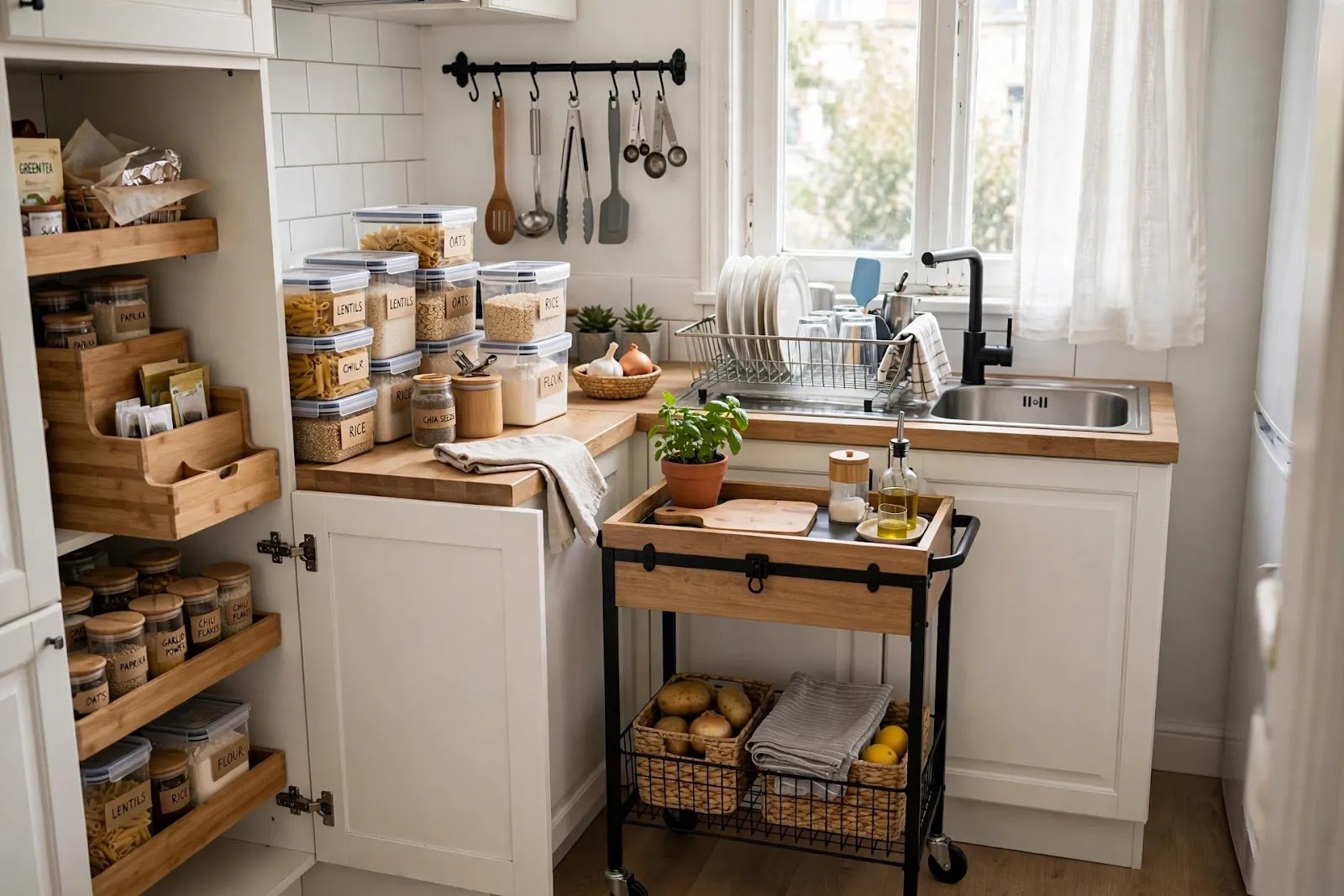
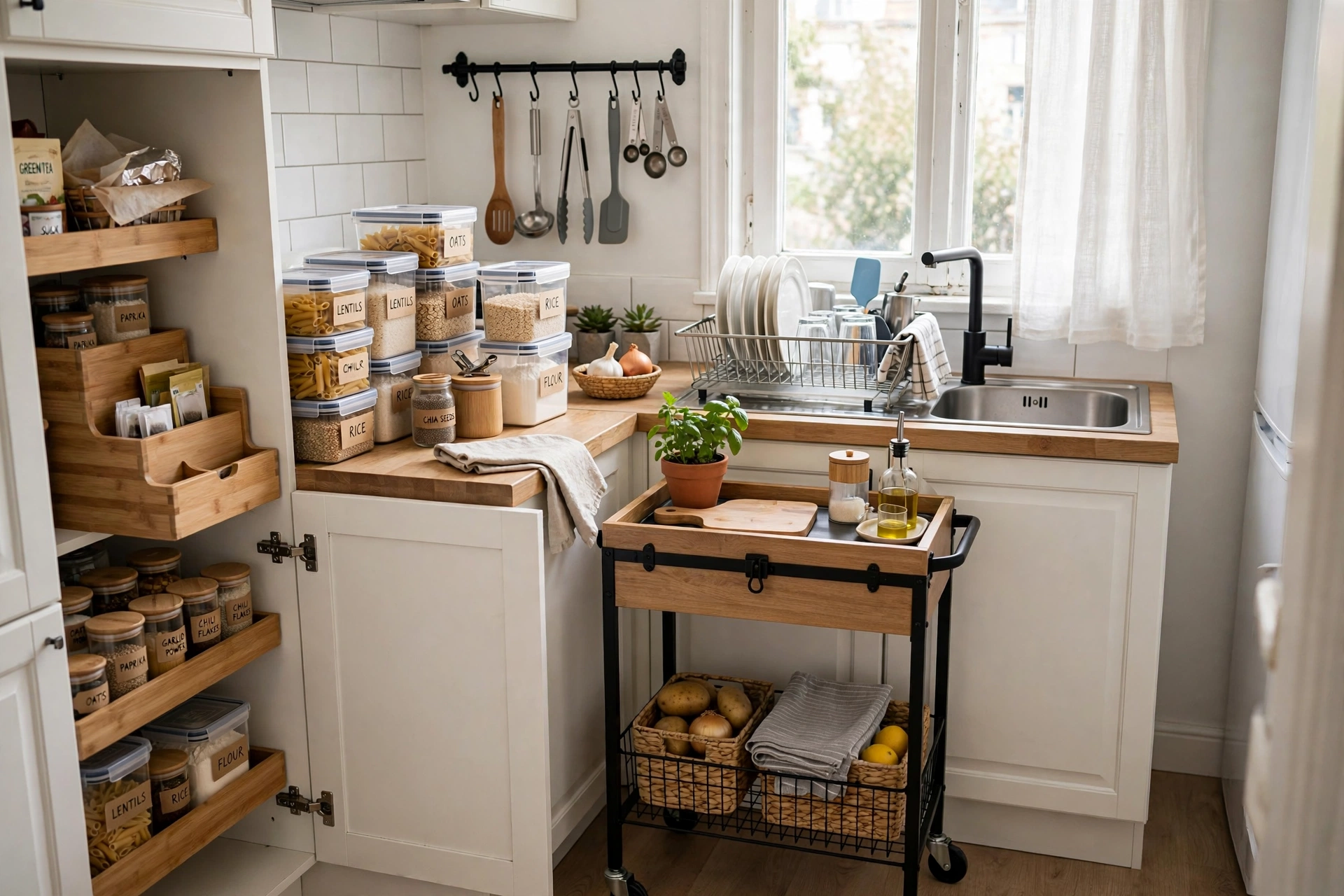
Walls are free real estate. A stainless rail with S-hooks (IKEA KUNGSFORS, ~$15) mounted on a backsplash or wall holds utensils, mugs, and small pans — freeing an entire drawer. Magnetic knife strips ($10–$15) get the knife block off the counter.
No drilling? Use heavy-duty adhesive hooks ($8 for a multi-pack) rated for kitchen humidity. They hold spatulas, measuring cups, and lightweight pans with zero holes. Your counters just gained a square foot.
3. Add an Over-the-Sink Dish Rack ($25–$35)
Countertop dish racks eat precious counter space. An over-the-sink roll-up rack ($20–$30 on Amazon) sits across the sink basin — dishes drip directly into the sink, and it rolls up when not in use. Zero footprint when stored.
For tiny sinks, a $15 over-the-sink shelf rack adds a whole extra “counter” for drying or prep. It’s the single highest-impact $25 you can spend in a small kitchen.
4. Tier Your Cabinets ($12–$20)
Deep cabinets waste their back half. Tiered shelf risers ($12–$18 for a set) double every shelf into two levels — cans and spices in front, taller items behind, all visible. No more buying a third jar of cumin because you couldn’t see the first two.
Under-sink? A $15 two-tier organizer turns the plumbing obstacle course into usable storage for cleaning supplies. Measure first — under-sink spaces vary wildly.
5. Decant Into Clear Containers ($15–$25)
Bulky boxes and bags waste space and hide what you have. A set of 8–12 stackable clear containers ($15–$25) for flour, rice, pasta, and snacks cuts pantry volume by a third and looks incredible. Square containers waste less space than round ones.
Label everything with a $5 chalk-marker set. The “expensive organized pantry” look is 90% matching containers and labels — the contents barely matter.
6. Hang Pots From a Ceiling or Wall Rack ($20–$40)
Pots and pans are the bulkiest kitchen items. A wall-mounted pot rail ($20–$30) or ceiling rack ($30–$40) gets them out of cabinets entirely. In a small kitchen, this frees an entire cabinet for food storage.
Renter option: a $25 freestanding pot rack that leans against the wall — zero mounting, same result. Hang daily-use pans within arm’s reach of the stove for a pro-kitchen feel.
7. Create a Coffee/Tea Station Tray ($10–$15)
Corral the morning chaos: a $10–$12 tray or small basket holds the coffee maker, mugs, sugar, and spoons in one “station.” It turns scattered clutter into an intentional vignette and frees the rest of the counter.
Same trick works for cooking oils and spices near the stove — one tray, everything contained, wipes clean in seconds. Contained clutter reads as organized; scattered clutter reads as mess.
8. Use the Inside of Cabinet Doors ($8–$15)
The inside of cabinet doors is invisible storage. Adhesive organizer racks ($8–$12) on the inside of the under-sink door hold sponges, brushes, and trash bags. A $10 mounted paper-towel holder inside a cabinet door frees counter space.
Spice racks designed for door-mounting ($12–$15) turn one cabinet door into a full spice library. Measure your door clearance first — some doors sit too close to shelves.
9. Rolling Cart as Flexible Island ($30–$45)
No island? No problem. A narrow rolling cart (IKEA RASKOG at $30 or similar) adds prep space, storage, and mobility. Roll it where you need it, tuck it in a gap when you don’t. Use the top for prep, middle for tools, bottom for bulk items.
In galley kitchens, a $35 fold-down wall table creates an instant breakfast bar or extra prep surface, then disappears. Small kitchens need furniture that multitasks.
10. Zone Your Kitchen Like a Pro (Free)
Pro kitchens work by zones: prep, cook, clean, store. In a small kitchen, zoning matters more, not less. Keep knives, cutting boards, and mixing bowls near your main prep spot. Store pots near the stove, dishes near the dishwasher/sink.
The 10-minute version: stand in your kitchen and notice what you reach for — then move it closer to where you use it. This free reorganization often beats any purchased organizer. Work with your habits, not against them.
Sample Budget: Organized Kitchen Under $100
Total estimate: ~$94 for a kitchen that feels twice as big.
FAQ
How do I organize a very small kitchen with no pantry?
Think vertical and hidden: wall rails, inside-door organizers, over-sink racks, and tiered shelf risers. Decant dry goods into stackable square containers. The goal is using walls, doors, and air space — not just shelves.
What’s the cheapest way to get more kitchen counter space?
Remove what doesn’t belong, then add an over-the-sink rack ($25) and a rolling cart ($30). Together they effectively add 4+ square feet of usable surface for under $60.
How can renters organize a kitchen without drilling?
Adhesive hooks and racks, tension rods inside cabinets, freestanding storage, over-the-sink accessories, and rolling carts. Everything in this guide except the wall rail has a no-drill alternative.
Should I decant everything into containers?
Decant dry goods you buy in bulk (flour, rice, pasta, cereal, snacks). Start with the 5 most visually chaotic items — that’s where the payoff is.
How do I keep a small kitchen organized long-term?
One-in-one-out rule for gadgets, a 5-minute nightly reset, and a monthly 10-minute declutter of one cabinet. Small kitchens stay organized through habits, not products.
✨ You may also love:
📚 Love these ideas? Get the complete book!
This article is just a taste! My 123-page eBook “Budget Decor, Big Style” covers every room of your home — with budget tables, step-by-step room recipes, checklists and pro secrets that make any home look expensive, for less.
Use code LAUNCH30 for 30% OFF 🎉