
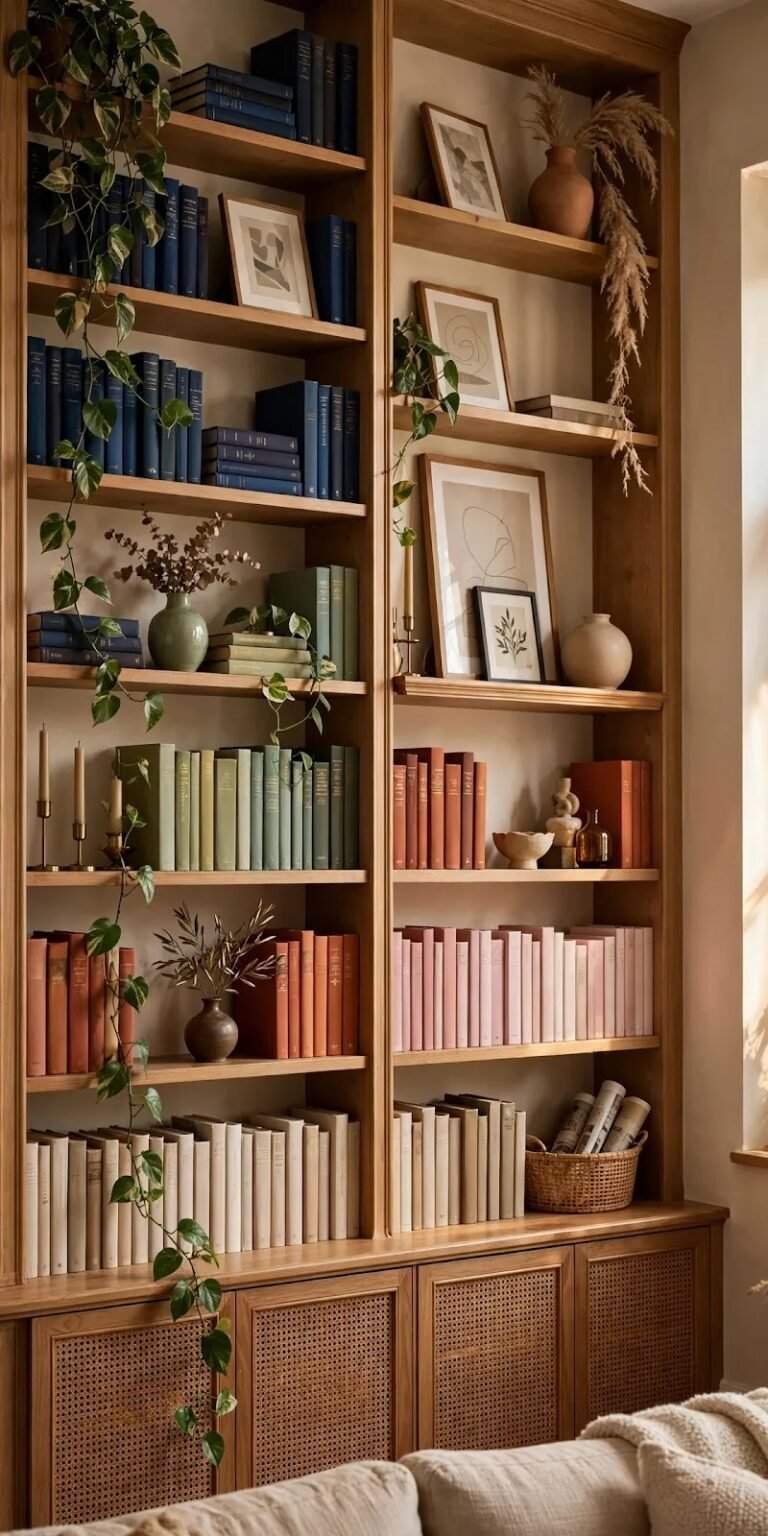
Living Room Built-In Bookshelf Styling Ideas on a Budget (2026 Guide)
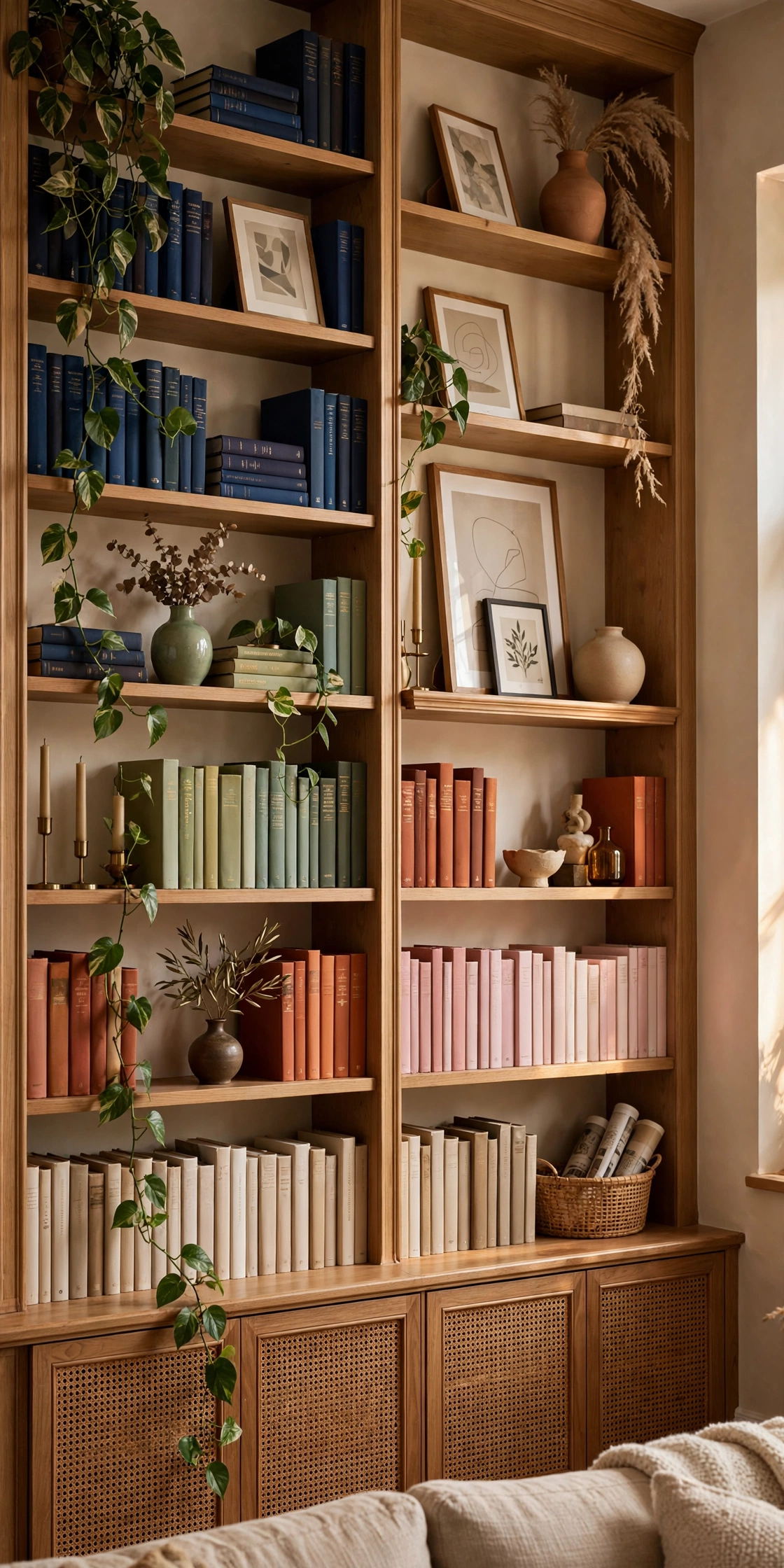
Living Room Built-In Bookshelf Styling Ideas on a Budget (2026 Guide)
Style living room built-in bookshelves like a designer on a budget! 10 ideas — book arranging, decor objects & styling tricks under $30 each.
For the full set of 9 looks for small spaces and big style, see our living room decor ideas.
Built-in bookshelves are a living room’s best feature — and its biggest styling challenge. The designer secret: it’s not about expensive objects, it’s about arrangement. Here are 10 budget ideas to style yours. If you want the shelves to feel more current, these modern living room ideas show how clean lines and simple styling keep a built-in looking fresh, not cluttered.
10 Built-In Bookshelf Styling Ideas on a Budget
1. The 60-30-10 Formula (Free)
60% books, 30% decor objects, 10% empty space. Count your shelves and allocate. Most bad bookshelves are 95% crammed books — the fix is subtraction, not shopping.
Pull everything off, then rebuild with the ratio. Free, transformative.
Count before you start: a standard 5-shelf bookcase has about 150 cm of shelf width per shelf, so 60% books means roughly 90 cm of books per shelf. Pull everything off and sort into three piles — keep, relocate, donate — before a single book goes back. Mistake to avoid: counting the 10% empty space as failure; an empty stretch of shelf is what lets the eye rest, and without it the bookcase reads as a storage unit, not a styled feature.
2. Color-Block Your Books ($0–$15)
Group books by spine color (all reds together, all blues together). $0 if you own the books; $10–$15 thrifted fillers in missing colors. The rainbow-or-gradient shelf is the most-photographed look for a reason.
Alternative: turn spines inward (all pages out) for the $0 neutral-texture look.
Work shelf by shelf: pull all the books off one shelf, sort them into colour piles on the floor, and rebuild that shelf before moving on — doing the whole bookcase at once creates chaos. If a colour is missing, a $10–$15 thrifted set of 3–4 books in that shade fills the gap. Mistake to avoid: a full rainbow on every shelf; the effect works when one or two shelves carry the colour gradient and the rest stay quiet, or the room looks like a paint chart.
3. Horizontal Stacks ($5–$12)
Not every book stands up. Lay 3-5 books flat in stacks — they become pedestals for small objects. $8 bookends hold the vertical sections; stacks break the monotony.
Vary stack heights across shelves for rhythm.
Stack 3–5 books flat with the largest at the bottom and the smallest on top, and leave 5 cm of clear shelf above the stack so it reads as a pedestal, not a pile. A small object on top — a candle, a stone, a tiny plant — should be no taller than 10 cm or it topples the look. Mistake to avoid: stacks of books with wildly different sizes; a paperback on top of a coffee-table book overhangs and looks like it is about to slide off.
4. Thrifted Decor Objects ($3–$12 each)
$5 vases, $3 candlesticks, $8 small sculptures, $4 interesting boxes. Thrift stores are built-in-styling goldmines — one $30 trip fills a whole bookcase.
Rule: one object per “moment,” grouped in odd numbers.
Set a $30 budget and a list before you go thrifting: one vase, one candlestick, one box, one small sculpture. Check each piece for chips and wobble — a vase that rocks will fall off a shelf. Wash thrifted ceramics in hot soapy water; a $5 vase can carry a smell from its previous home. Mistake to avoid: buying objects just because they are cheap; a $3 item you do not love costs shelf space, and shelf space is the whole point.
5. Framed Art on Shelves ($8–$20)
$10 small framed prints leaned against the back of a shelf add depth and personality. $8 thrifted frames + free printable art = gallery-shelf hybrid. The same idea works on a larger scale, and a gallery wall above the sofa uses the same layering and spacing rules, just with bigger frames.
Layer art in front of books — depth is the designer trick.
Lean frames at a slight angle against the shelf back, with the bottom edge 2–3 cm in front of the books behind them so the art reads as a layer, not a blockage. A 20 by 25 cm frame costs $8–$12 thrifted; print free art at home on 200 gsm card for $1–$2 a sheet. Mistake to avoid: a frame taller than the shelf opening — measure the clearance first, because a frame wedged tight against the shelf above looks cramped and cannot be dusted.
6. Trailing Plants ($10–$20)
$12 pothos in a $8 pot on the top shelf, trailing down. One plant per bookcase softens all the hard lines. Faux trailing plants ($15) work if the shelf is high and dry.
A pothos in a 15 cm pot costs $10–$12, and a hanging planter adds $5–$8; water it every 10–14 days and let the soil dry between waterings, because a trailing plant on a high shelf is easy to overwater. Train the vines along the shelf edge with small clear hooks ($3 a pack) so they cascade instead of dangling in front of the books. Mistake to avoid: a real plant on a shelf with no light; it yellows in weeks, and a dying plant is worse than no plant.
7. Baskets for the Ugly Stuff ($12–$25)
$15–$20 lidded baskets or $12 fabric bins on the bottom shelves hide remotes, chargers, and clutter. The bottom shelf is the “junk drawer” — contain it beautifully.
Measure the shelf opening before buying: baskets should be 2–3 cm shorter than the shelf height and 5 cm narrower than the opening, so they slide in and out without scraping. A lidded seagrass basket 30 by 30 cm costs $15–$20; label the front with a $2 chalk tag so you know what is inside. Mistake to avoid: open-top bins on the bottom shelf; they become visible clutter within a week, and the whole point of the basket is to hide the mess.
8. Picture Ledge Layering ($15–$30)
$15–$25 narrow picture ledges mounted inside deep shelves create tiered display space. Lean small frames and objects at two depths — instant dimension.
A 60 cm picture ledge costs $15–$25 and mounts with two screws into a wall stud or with anchors rated for 10 kg; mount it 10 cm above the shelf base so frames lean without sliding. Overlap frames by 3–5 cm for a layered look, and keep the tallest frame at the back. Mistake to avoid: a ledge loaded with heavy frames on drywall anchors alone; it will sag and eventually pull out, so always find at least one stud.
For safe anchoring, see the CPSC Anchor It! guide.
9. Paint the Backs ($25–$45)
One quart of paint ($15–$25) on the shelf backs in a contrasting color (deep green, navy, terracotta) makes everything in front pop. The #1 built-in upgrade designers recommend.
Peel-and-stick wallpaper ($25) on backs = same effect, renter-safe.
One quart of paint ($15–$25) covers the backs of a standard 5-shelf bookcase with two coats; use a small foam roller for a smooth finish and painter’s tape along the shelf edges. Let each coat dry 4 hours, and wait 24 hours before restyling so books do not stick. Mistake to avoid: painting the shelf surfaces themselves; paint on the horizontal boards chips under the weight of books, while the backs stay pristine.
10. Lighting the Shelves ($15–$30)
$20 LED puck lights (3-pack, remote) or $15 battery picture lights on top shelves. Lit shelves look custom and expensive — the glow draws the eye and adds evening ambiance.
Battery puck lights cost $15–$20 for a 3-pack with a remote; stick one under each shelf with the included adhesive, centred 5 cm from the front edge so the light washes down the books instead of glaring out. Expect 100+ hours from a set of AA batteries, and use the timer mode (4–6 hours) so they switch off automatically. Mistake to avoid: cool-white pucks; at 6000K they make wood look grey, while warm-white 2700K makes the shelves glow.
Great bookshelf styling is 90% editing and 10% shopping — pull everything off, keep what earns its place, and rebuild with intention. Live with it for a week, then adjust. The best shelves evolve slowly, collecting objects with stories rather than filling up in one shopping trip. Once the shelves are styled, the seating matters too, and curved boucle sofa styling shows how a curved sofa can soften the straight lines of built-in shelves.
5 Bookshelf Styling Mistakes to Avoid
No breathing room. Every inch filled = visual noise. The 10% empty space in the 60-30-10 formula isn’t wasted — it’s what makes the other 90% look intentional.
All books, no objects (or vice versa). Pure-book shelves look like a library annex; pure-decor shelves look like a store display. The mix is what makes it a styled living room feature.
Ignoring the top. The top shelf is visible from across the room — dusty forgotten boxes up there ruin the whole effect. Style it deliberately or hide storage in matching boxes.
Tiny objects on deep shelves. A 3-inch trinket on a 12-inch-deep shelf looks lost. Scale objects to shelf depth: bigger pieces, or group small ones on stacks and trays.
Forgetting to dust the plan. Styled shelves need a 10-minute monthly dusting. If that’s unrealistic, choose fewer, larger objects and enclosed baskets — low-maintenance styling beats high-maintenance styling you abandon.
FAQ
How do you style bookshelves without looking cluttered?
The 60-30-10 rule (books/decor/empty space), odd-number groupings, and varying heights. Step back 10 feet after each shelf — if any shelf looks “busy,” remove one thing.
Should books be organized by color or subject?
For looks: color. For use: subject. Most living rooms choose color — books you actually reread live elsewhere. It’s decor that happens to be books.
What do you put on the top shelf of a bookcase?
Tall items: large vases, trailing plants, big art leaned against the wall. The top shelf is seen from across the room — it needs height and simplicity, not small fussy objects.
✨ You may also love:
📚 Love these ideas? Get the complete book!
This article is just a taste! My 123-page eBook “Budget Decor, Big Style” covers every room of your home — with budget tables, step-by-step room recipes, checklists and pro secrets that make any home look expensive, for less.
Use code LAUNCH30 for 30% OFF 🎉
As an Amazon Associate I earn from qualifying purchases. Some links in this article are affiliate links — if you buy through them, we may earn a small commission at no extra cost to you.
Still looking for something?
Search every idea on ModernVibeHome - try pantry, small bathroom or Christmas.



One Comment