
A small living room has to do more work than any other room in the home: relaxing, hosting, working, and storing everything that has nowhere else to go. When the room is small and the budget is tight, that list can feel impossible. It is not. Treat the room as one connected plan instead of a pile of separate purchases, and spend first on the pieces that change how the room feels every single day.
Start with the total budget, not with a single item. Decide what the whole room can cost, then divide it before you shop: roughly half for seating, a quarter for lighting and textiles, and the rest for storage and wall decor. That order matters. A good sofa beats a beautiful side table you barely notice, and warm light you use every evening beats a third cushion. Once the big pieces are settled, the smaller choices get easier, because you can see what is actually missing.
Buy first: a sofa that fits, one good lamp, a rug in the right size, and one storage piece that hides clutter. Skip, at least at first: matching sets, trendy accent chairs, oversized coffee tables, and anything bought only because it was on sale. A room filled slowly, one deliberate piece at a time, almost always looks better than a room filled in a single weekend. The nine looks below follow that order, and together they cover the whole room, from the floor plan to the walls.
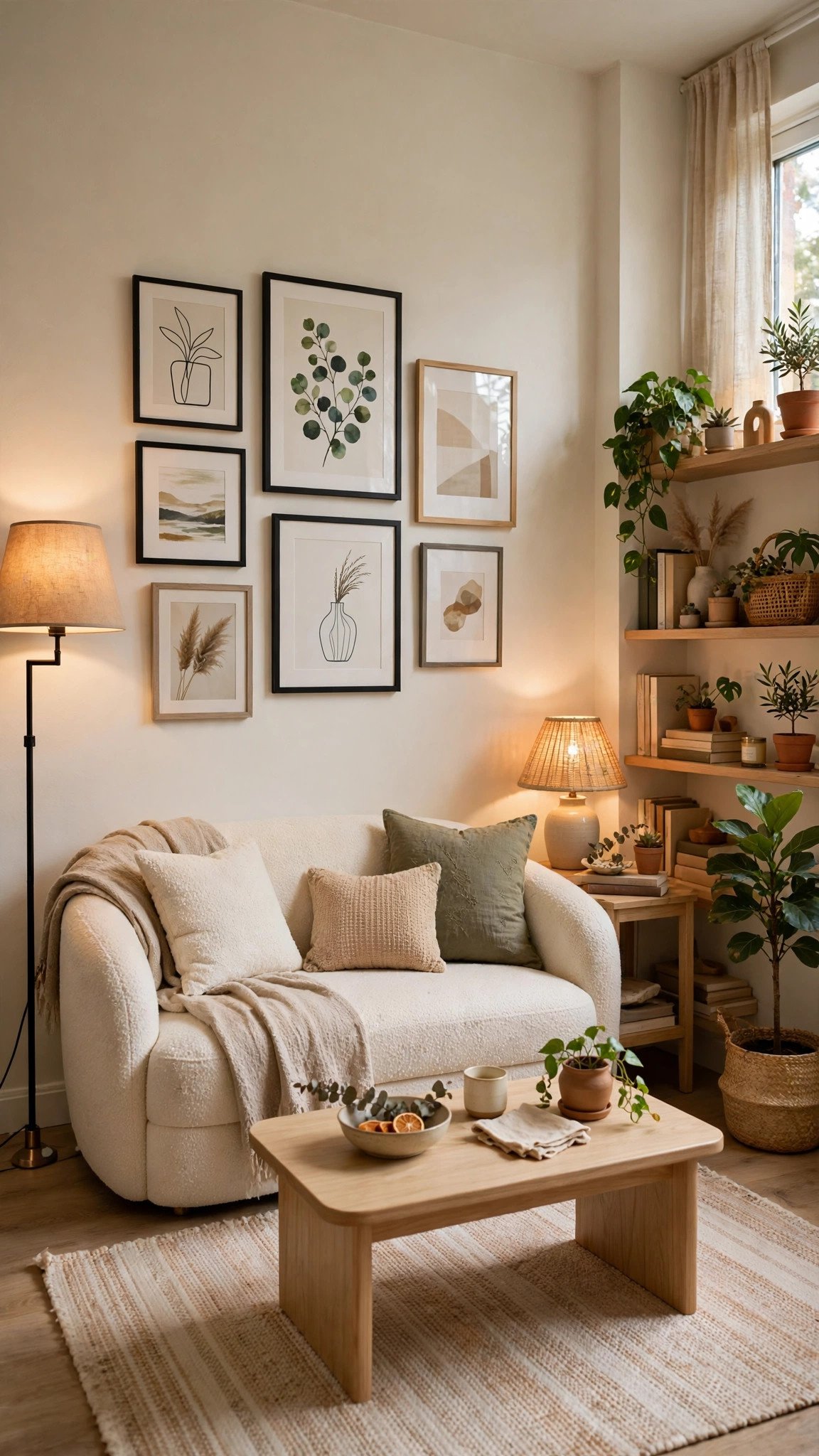
## Budget and Modern Foundations
A strong living room starts with two decisions: how much you will spend, and what shape the room should take. Get those right and every later choice becomes simpler.
### 1. Start With a Plan That Protects Your Budget
The fastest way to overspend on a living room is to shop without a plan. A plan does not need to be complicated. Measure the room first, wall to wall, and write the numbers down. Note the door swings, the radiator, the plug sockets, and the window height. Then sketch the layout on paper, even roughly. A sofa five centimetres too long can block a walkway for years, so these measurements are worth an hour of your time.
Buy in the right order. Seating comes first, because it sets the scale for everything else. Lighting comes second, because it changes how every colour in the room reads after dark. Textiles, such as curtains and cushions, come third, because they soften hard edges and can be changed cheaply later. Decor comes last. If money runs short, a room with a good sofa, warm light, and bare walls still works.
There are several reliable ways to keep costs down without cutting corners that matter. Choose a solid, simple sofa frame in a durable fabric rather than a fashionable shape in a delicate one. Look for second-hand storage, such as a solid wood cabinet or a good shelving unit, and paint it to match the room. Use one large piece of art, or a set of frames you already own, instead of many small purchases. Swap cushion covers seasonally instead of buying new cushions. And keep a short list of the three things you still want, so an impulse buy does not eat the money set aside for the piece you actually need. For a full room-by-room breakdown of low-cost choices, from paint to lighting to second-hand finds, see these budget living room decor ideas.
### 2. Give a Small Room a Clean, Current Shape
A modern living room is not about buying the newest furniture. It is about clear lines, honest materials, and space to move. In a small room, that approach pays off twice, because every visual break, every fussy detail, and every extra piece of furniture makes the room feel smaller. Start by choosing one main line for the room: straight and low, or soft and curved, and let the other pieces support it rather than compete with it.
Keep the largest pieces simple. A low sofa with straight arms, a plain rectangular coffee table, and a flat-weave rug give the eye somewhere to rest. Then add warmth through texture rather than through pattern: a wool throw, a linen cushion, light wood, matte black metal. Two or three materials are enough. More than that, and the room starts to look busy. Leave at least 75 centimetres of clear walkway between the sofa and the coffee table, and the same between the coffee table and the television or media unit, so the room works for real life, not just for photographs.
Colour in a modern small room works best when it is restrained. One neutral base, such as warm white, soft grey, or pale oak, plus one deeper accent, is usually enough. The accent can live on one wall, in the cushions, or in one large piece of art, but repeat it at least three times so it looks deliberate. Keep the ceiling and the largest surfaces light, because dark, heavy surfaces overhead shrink a small room fast. If you want the full picture, including layout diagrams, furniture proportions, and a checklist for each zone of the room, read these modern living room ideas.
## Colour That Makes a Small Room Feel Rich
Colour is the cheapest way to change a living room, and the easiest way to get it wrong. In a small room, the right colour gives the room personality and makes the space feel intentional rather than cramped.
### 3. Go Deep and Moody With Emerald Green
Emerald green is a bold choice, and that is exactly why it works in a small living room. A small room painted in a pale, safe colour can feel washed out and unfinished. One deep green wall, or a green sofa against warm white walls, gives the room a clear focal point and makes everything else in the room look more considered. The key is to commit in one place and stay calm everywhere else.
If you paint, start with a single wall, ideally the wall behind the sofa or the television wall. Keep the other walls warm white, and keep the ceiling white, so the room keeps its height. If you would rather not paint, a green sofa, green velvet curtains, or a large green rug can carry the same effect. Whichever route you choose, pair the green with warm metals, such as brass or aged gold, and with light wood. Cool silver and grey can make emerald look cold, while warm brass makes it glow, especially in the evening.
Lighting matters more with a dark colour than with a pale one. A dark wall absorbs light, so a moody room needs more of it, not less. Aim for three sources: a ceiling light or floor lamp for general light, a table lamp near the sofa for reading, and a small warm light, such as a picture light or a candle-style lamp, to lift the darkest corner. Use warm white bulbs, around 2700K, because cool white bulbs make deep green look flat and grey. For paint pairings, furniture choices, and a step-by-step plan for a green room that still feels bright, explore this moody emerald green living room.
### 4. Try Olive Green for a Softer, Earthier Room
Olive green is emerald’s quieter cousin, and for many small living rooms it is the easier choice. It is softer, earthier, and more forgiving, which makes it a good fit for rooms that get little natural light or that need to feel calm rather than dramatic. Olive works beautifully with the materials most small homes already have: light oak, linen, rattan, cream walls, and worn leather.
Use olive as a middle tone, not as a dark accent. An olive sofa, olive curtains, or olive cushions on a cream sofa all work, and they pair naturally with warm whites and pale wood. If you paint with olive, choose a warm, muted shade rather than a yellow-heavy one, and test it on the wall at different times of day, because olive can shift from sage to khaki as the light changes.
Olive also connects a small room to the outdoors. A plant or two, a wooden bowl, a linen throw, and a woven basket are enough to complete the feeling. Avoid pairing olive with too many other strong colours. One warm accent, such as terracotta, mustard, or warm brass, is plenty. Two or three competing accents will fight the green and make the room feel restless. For shade-by-shade guidance, sofa pairings, and ideas for olive in both bright and low-light rooms, see these olive green living room ideas.
### 5. Add a Touch of Luxury Without a Luxury Budget
A luxury living room is not defined by how much it costs. It is defined by how it feels: calm, uncluttered, well lit, and finished. In a small room, that feeling comes from restraint and from a few well-chosen details, not from filling the space with expensive objects. Start by removing one thing from the room before you add anything. A luxury room has breathing space, and an overfilled small room can never feel luxurious, whatever you spend.
Choose one or two materials that read as rich and use them consistently. Velvet, marble, brass, and dark wood are the classic choices, and a little goes a long way. A velvet cushion, a brass floor lamp, and a marble-topped side table can lift a plain sofa and a simple rug into something that feels considered. Keep the colour palette tight: a warm neutral base, one deep tone, and one metallic accent. That discipline is what separates a luxurious room from a busy one.
Match your metals, so the lamp, the picture frames, and the cabinet handles share the same finish. Hide cables and remotes. Choose curtains that hang to the floor, hung high and wide so the window looks larger. Use a large mirror, or one large piece of art, instead of many small decorations. And keep the surfaces mostly clear: one book, one vase, one candle on a coffee table looks richer than a crowded display. For the full guide, including affordable swaps for high-end pieces and a checklist for each surface in the room, read these elegant luxury living room ideas.
## Sofa and Seating
The sofa is the largest object in most small living rooms, so it decides the shape of the whole room. Get it right and the rest of the furniture falls into place around it.
### 6. Soften the Room With a Curved Boucle Sofa
A curved boucle sofa does something a straight sofa cannot: it softens a small, boxy room. The rounded back breaks up hard corners, the pale nubby fabric adds texture without pattern, and the low, generous shape invites people to sit and stay. In a small room, that softness matters, because straight lines and hard surfaces can make a compact space feel sharp and unwelcoming.
Measure before you fall in love with the shape. A curved sofa needs more floor space than its width suggests, because the curve eats into the room at the sides. Leave at least 75 centimetres behind it if it floats in the room, and check that the curve does not block a door or a walkway. A two-seater curve, roughly 160 to 180 centimetres wide, suits most small rooms better than a three-seater, and it leaves room for a side table and a floor lamp, which a larger sofa would crowd out.
Style it simply, because the fabric is already the feature. Cream or ivory boucle pairs well with light oak, black metal, and warm brass. Add one contrasting texture, such as a smooth leather cushion or a linen throw, so the room does not feel all soft and no structure. Keep the rug plain and pale, and choose a round coffee table, which echoes the sofa’s curve and is easier to walk around. Protect it with washable throws if you have children or pets, and vacuum weekly, because boucle holds dust in its loops. For sizing, styling, and care advice, including which rooms suit a curved shape and which do not, see this guide to curved boucle sofa styling.
## Walls and Storage
Walls are the most underused surface in a small living room. They hold the art that gives the room character and the storage that keeps clutter off the floor, without taking a single centimetre of floor space.
### 7. Hang a Gallery Wall Above the Sofa
The wall above the sofa is the natural focal point of a living room, and a gallery wall is the most flexible way to fill it. It lets you mix art, photographs, and prints you already own, and it can grow over time, one frame at a time, which suits a budget-first approach. The trick is to plan the arrangement on the floor before a single nail goes into the wall.
Start with the size. The finished gallery should span roughly two-thirds of the sofa’s width, and its centre should sit at eye level, about 145 to 155 centimetres from the floor. Leave 15 to 20 centimetres between the top of the sofa and the bottom of the lowest frame, so the two feel connected rather than floating apart. Lay the frames on the floor first and photograph the arrangement, moving pieces until the spacing looks even, with 5 to 8 centimetres between frames.
Keep the frames consistent in one way and varied in another. Matching frames with varied art, or varied frames in the same colour, both work. Mixing every frame colour, every size, and every style at once usually looks messy rather than collected. Use a paper template on the wall: trace each frame on paper, tape the paper up, and check the layout from the doorway before you hang anything. For frame layouts, spacing diagrams, and ideas for mixing art with family photos, read this guide to a gallery wall above the sofa.
### 8. Style Built-In Bookshelves So They Work Hard
Built-in bookshelves are one of the best features a small living room can have, because they store a large amount without taking up floor space. The mistake is to treat them as a place to put everything you own. A shelf packed edge to edge with books and objects looks like storage, not style. A shelf styled with intention looks like part of the room’s design and still holds a great deal.
Work in groups, not in rows. Place books in small stacks, some upright and some lying flat, and leave empty space between groups so the eye can rest. A good rule is to fill about two-thirds of each shelf and leave one-third empty. Mix in objects of different heights: a vase, a framed photo, a small plant, a decorative box. Repeat one or two colours across the shelves so the display feels connected, and keep the heaviest items on the lowest shelves, both for safety and for visual balance.
Use the shelves for real storage too, not just display. Baskets and boxes on the lower shelves can hide cables, chargers, games, and children’s toys, which keeps the room tidy without a separate storage unit. Dust weekly, because a built-in unit shows dust faster than a closed cabinet, and rotate one or two objects each season so the display feels fresh. For step-by-step styling, shelf-by-shelf layouts, and ideas for mixing books with storage baskets, see this guide to living room built-in bookshelf styling.
## Tiny Apartments
A tiny apartment living room asks the most from the least space, and it rewards the same principles as the rest of this guide, applied more strictly: every piece must earn its place, and nothing can block light or movement.
### 9. Make a Tiny Apartment Room Do Everything
In a tiny apartment, the living room is rarely just a living room. It is also a dining room, an office, and sometimes a guest bedroom. The layout has to reflect that, or the room will feel crowded no matter how pretty it is. Start by naming the zones: one for sitting, one for working or eating, and one for storage. Even in a room of ten square metres, a rug can mark the sitting zone and a small desk or fold-down table can mark the work zone, and that separation makes the room feel larger.
Choose furniture that changes shape. A sofa bed or a daybed, a coffee table that lifts to dining height, a stool that works as a side table, and nesting tables that tuck away when guests leave are all worth their cost in a tiny room. Keep the largest pieces on legs, so you can see floor underneath them, because visible floor makes a room feel bigger.
Storage must be vertical. Tall, narrow shelving, hooks behind the door, a storage ottoman, and baskets on top of a wardrobe use space that would otherwise be wasted. Keep the colour palette pale and consistent across zones, so the room reads as one space rather than three cramped corners. Use one curtain, one rug style, and one metal finish throughout. Keep a clear path from the door to the window at all times; if you have to step around furniture to cross the room, the layout needs another try. For floor plans, multi-use furniture picks, and storage ideas sized for real apartments, explore these tiny apartment living room ideas.
## Frequently Asked Questions
**What is the best sofa size for a small living room?**
Measure the wall first, then choose a sofa at least 15 centimetres shorter than that wall, so it does not crowd the corners. For most small rooms, a two-seater of 160 to 180 centimetres, or a compact three-seater up to 200 centimetres, works best. Leave 75 centimetres of walkway in front of it and check door swings before ordering.
**How can I make a small living room look bigger on a budget?**
Keep the largest surfaces pale, hang curtains high and wide, choose furniture on legs so floor shows underneath, and use one large mirror or one large piece of art instead of many small decorations. Good lighting, especially a warm floor lamp in the darkest corner, also makes a real difference.
**What colour should I paint a small living room?**
Warm white is the safest choice, because it keeps the room bright and lets furniture and art carry the colour. If you want a deeper colour, use it on one wall only, keep the ceiling white, and add warm lighting so the dark wall does not shrink the room.
**How do I arrange furniture in a tiny apartment living room?**
Mark the zones first, sitting, working, and storage, then place the sofa against the longest wall, float a rug to define the sitting area, and keep the path from door to window clear. Choose pieces that fold, stack, or change shape, and store vertically wherever you can.
## More Living Room Ideas
If one of the looks above caught your eye, start there. The budget-first plan, the emerald green room, and the tiny apartment guide each work as a complete project on their own, and each one links back to the other ideas in this guide. Read the full set of nine looks above, pick the one that solves your biggest problem first, and build the room one deliberate piece at a time.