
How to Make a Small Apartment Look Bigger: 9 Proven Tricks
How to Make a Small Apartment Look Bigger: 9 Proven Tricks
Small apartment feeling cramped? These 9 designer-approved tricks — mirrors, lighting, and smart furniture picks — make any tiny space feel twice as big.
Living in a small apartment doesn’t mean living in a cramped one. Interior designers have used the same handful of visual tricks for decades to make 400-square-foot studios feel airy and open — and most of them cost little or nothing.
The secret? It’s not about square footage. It’s about sightlines, light, and scale.
9 Designer Tricks to Make a Small Apartment Look Bigger
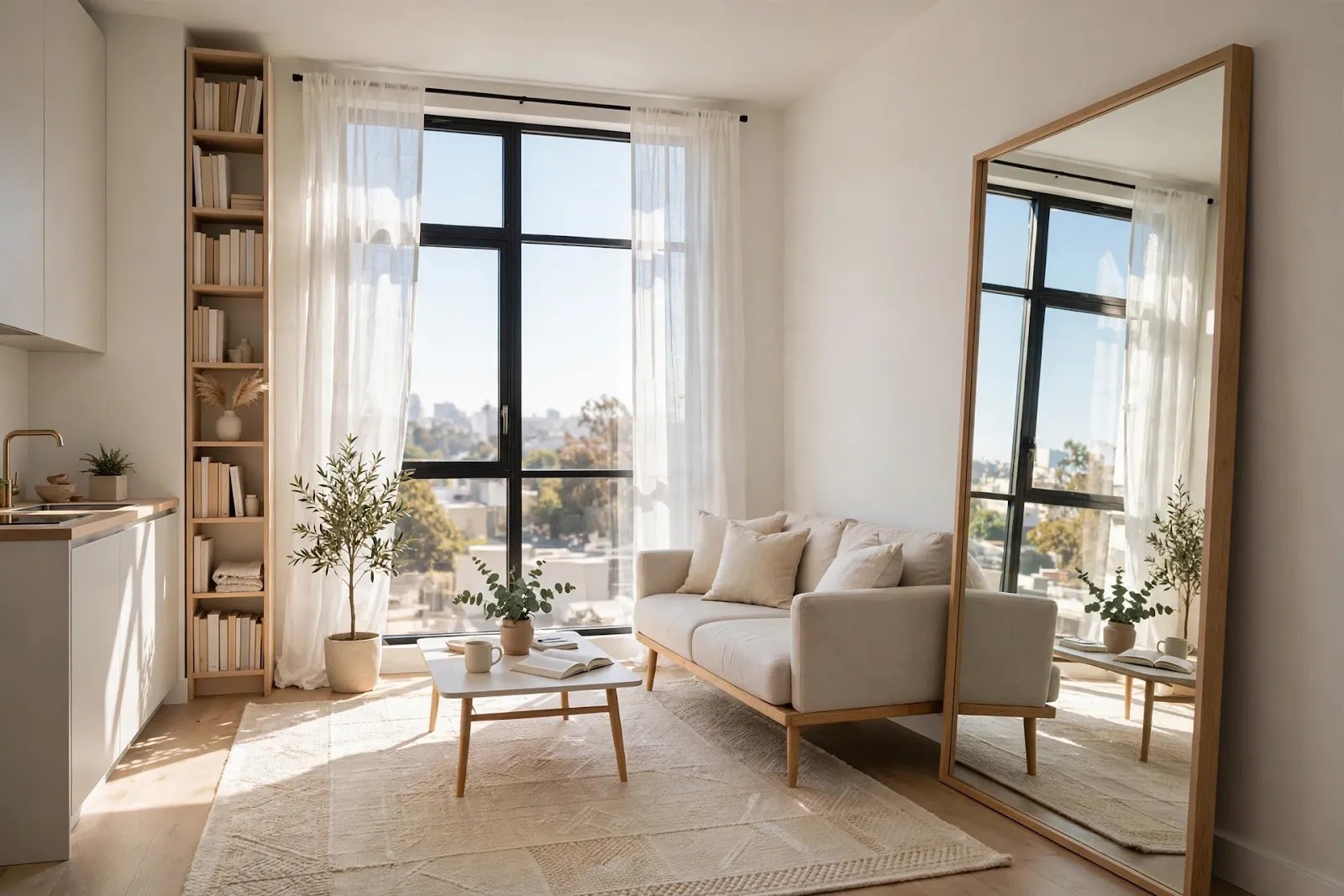
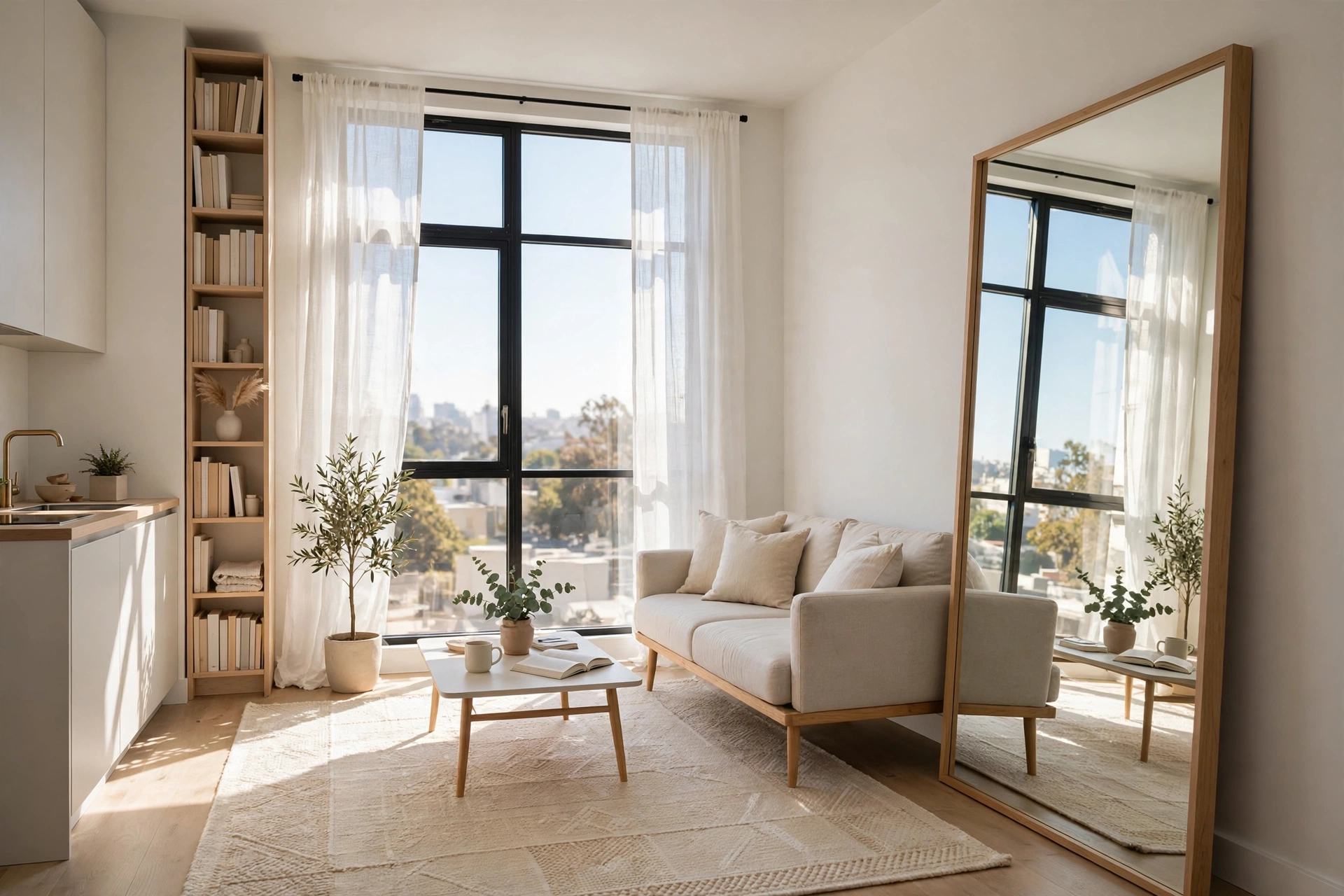
1. Hang a Large Mirror Opposite Your Windows
A large mirror placed directly across from a window bounces natural light deep into the room and visually doubles the space. Go big — aim for a floor-length leaning mirror (at least 55 inches tall). IKEA’s LOTS mirror is just $9.99.
Size it to the wall: a mirror at least 55 inches tall and 30 inches wide reads as a second window, while a small 12-inch mirror just looks like a decoration. Lean a floor mirror at a slight angle against the wall opposite your biggest window, and anchor it with a wall strap or furniture anchors — a leaning mirror in a rental is a safety must, not an option. Thrifted floor mirrors run $20 to $40, and a new one from IKEA or Amazon is $50 to $90. The mistake to avoid is hanging a mirror opposite a cluttered wall or a TV; it doubles the mess instead of the light, so point it at the window and a clean wall.
2. Choose Furniture With Exposed Legs
Furniture with slim, exposed legs lets you see the floor continuing underneath, which tricks your brain into perceiving more space. Look for 4–6 inches of clearance underneath sofas and dressers.
Shop for the right clearance: a sofa with 6-inch legs shows a full strip of floor, while a 2-inch leg barely reads as exposed at all. Mid-century-style sofas and dressers with tapered wood legs run $200 to $400 secondhand, and you can raise a low piece you already own with 4-inch furniture risers for $12 to $18. The mistake to avoid is pairing leggy furniture with a rug that hides the legs — keep the rug smaller than the furniture footprint, or skip the rug under that piece, so the floor stays visible. In a rental, this trick costs nothing if you simply pull furniture 2 inches off the wall.
3. Keep Your Furniture Low-Profile
Low-profile furniture leaves more visible wall above it, which makes ceilings feel dramatically taller. A low platform bed plus a low dresser can make an 8-foot ceiling feel like 9 feet.
Measure before you buy: a sofa back under 32 inches and a bed frame under 12 inches high keep the most wall visible. A low platform bed with storage drawers runs $250 to $450 and replaces a tall dresser, while a low media console at 20 inches high costs $120 to $200. The mistake to avoid is a tall headboard in a room with 8-foot ceilings — it eats the wall and makes the ceiling feel lower. Keep at least 24 inches of bare wall above your tallest low piece, and skip tall bookshelves in the main living area.
4. Use One Large Rug Instead of Several Small Ones
One large rug (5×7 feet minimum, 8×10 if it fits) unifies the space and draws the eye outward. Leave 6–12 inches of bare floor visible around the edges.
Measure your room first: in a 10-by-12-foot living room, an 8-by-10 rug leaves 12 inches of floor on each side, which is exactly the border you want. A washable 8-by-10 rug runs $120 to $200, a wool one $250 to $400, and a thrifted one $40 to $80. The mistake to avoid is a rug that stops at the sofa legs — the front legs of every seat should sit on the rug, or the room splits into pieces. If you rent and cannot afford a big rug, layer two flatweave rugs side by side with rug tape underneath; the seam hides under the coffee table.
5. Hang Curtains High and Wide
Mount your curtain rod 4–6 inches above the frame and extend it 6–10 inches beyond each side. Floor-length curtains in a light fabric create long vertical lines that stretch the room upward. This $25 trick delivers outsized results.
Buy the right length: curtains should just kiss the floor or puddle by 1 inch — a 96-inch panel fits 8-foot ceilings with a rod mounted 4 inches above the frame. Budget panels run $15 to $25 per pair, and a longer 84-inch rod is $20 to $30. Hang the rod with Command hooks or tension rods if your lease bans drilling. The mistake to avoid is a rod mounted right on the frame with short curtains — it shrinks the window and the wall. Wash or steam curtains before hanging so the folds fall straight instead of bunching at the hem.
6. Go Monochromatic With Your Color Palette
A room in one color family feels calm and continuous. Pick a light base (soft white, warm gray, pale sage) for walls and large furniture, then add personality through pillows, art, and plants.
Test paint before you commit: buy three sample pots at $5 each and paint 12-inch swatches on different walls, then look at them morning and evening. One accent wall in a deeper tone of the same family — a sage wall with pale sage bedding — adds depth without breaking the flow. Keep ceilings and trim one shade lighter than the walls, and limit bold colors to pillows and art under $30 each. The mistake to avoid is painting every wall a different pale color; the room reads as chopped up, so pick one base and repeat it in at least three places.
7. Layer Your Lighting (Ditch the Single Overhead)
Three or more light sources at different heights create pools of warm light that add depth. Budget move: a $15 floor lamp in a dark corner plus a $12 table lamp. Use warm-white bulbs (2700K) everywhere.
Plan three layers on a budget: one overhead or plug-in pendant ($25 to $40), one floor lamp in the darkest corner ($15 to $30), and one table lamp or string light for warmth ($12 to $20). Use 2700K warm-white LED bulbs in all three, and put the floor lamp on a smart plug so it turns on at dusk automatically. The mistake to avoid is one bright ceiling light that casts hard shadows — it flattens the room. If you rent, skip hardwiring and use battery LED strip lights under shelves for $10 to $15.
8. Use Glass, Lucite, and Reflective Surfaces
A glass coffee table takes up the same physical space as a wooden one but almost zero visual space. One or two transparent pieces are enough — check thrift stores and Facebook Marketplace for $20–$40 finds.
Shop thrift first: a glass coffee table runs $20 to $40 on Facebook Marketplace, a lucite chair $30 to $60, and a mirrored tray $10 to $15. Keep glass clean with a 50/50 vinegar and water spray, and use coasters so rings do not show. The mistake to avoid is filling the room with glass — one coffee table and one tray is enough; more glass looks cold and shows every fingerprint. Pair glass with one soft texture, like a wool throw or a linen pillow, so the room still feels lived in.
9. Draw the Eye Up With Vertical Storage
A tall, narrow bookcase pulls the eye toward the ceiling and makes walls feel taller while adding serious storage. In the kitchen, mount a rail with hooks for utensils instead of cluttering counters.
Anchor it properly: a 72-inch bookcase must be fixed to the wall withanti-tip straps, and use two studs or heavy-duty wall anchors rated for 50 pounds each. A narrow 12-inch-wide bookcase costs $60 to $120, and floating shelves at $15 to $25 each give the same lift without a floor footprint. The mistake to avoid is overloading the top shelves — keep heavy books at waist height and light decor up top, or the shelf looks top-heavy and tips the eye down. In the kitchen, a wall rail with S-hooks ($12 to $18) frees a whole drawer.
Quick-Start Checklist (Do This Weekend)
1. Lean a full-length mirror opposite your biggest window ($10–$40)
2. Re-hang your curtains high and wide ($25 for new rod + curtains)
3. Add one warm floor lamp to the darkest corner ($15)
If you rent, these renter friendly decor ideas keep every one of these tricks reversible, so you can try them without risking your deposit. And if your whole home is one open room, these studio apartment layout ideas show how to zone the sleeping, living, and dining areas you have just opened up.
FAQ
What colors make a small apartment look bigger?
Light, warm neutrals — soft white, warm beige, pale gray, light sage. They reflect the most light, which creates the sense of spaciousness.
Do mirrors really make a room look bigger?
Yes, but placement matters more than quantity. One large mirror opposite a window outperforms five small decorative mirrors. The mirror needs to reflect light or an attractive view.
Should I avoid dark furniture in a small apartment?
Not necessarily. Pair darker large pieces with light walls, a light rug, and good lighting. Avoid dark + bulky + low light all at once.
✨ You may also love:
📚 Love these ideas? Get the complete book!
This article is just a taste! My 123-page eBook “Budget Decor, Big Style” covers every room of your home — with budget tables, step-by-step room recipes, checklists and pro secrets that make any home look expensive, for less.
Use code LAUNCH30 for 30% OFF 🎉
As an Amazon Associate I earn from qualifying purchases. Some links in this article are affiliate links — if you buy through them, we may earn a small commission at no extra cost to you.
Still looking for something?
Search every idea on ModernVibeHome - try pantry, small bathroom or Christmas.




2 Comments