
Home Organization Ideas on a Budget: 10 Systems That Actually Stick (2026 Guide)
Home Organization Ideas on a Budget: 10 Systems That Actually Stick (2026 Guide)
Organization isn’t about buying bins — it’s about simple systems that survive real life. A good system does three things: it tells you exactly where something lives, it takes under 10 seconds to put away, and it still works on your busiest week. Every idea below costs $35 or less — most are free — and each one takes an afternoon at most. You do not need a bigger home or a full weekend. Pick one zone, finish it completely, and let the habit prove itself before you buy a single container. Here are 10 budget systems, room by room. If your first zone is the pantry, start with these pantry organization ideas. For the full set of 27 smart ways to organize every corner, see our small space organization ideas.10 Home Organization Ideas on a Budget
1. Home for Everything (Free)
Every item needs a designated home. Can you put it away in 10 seconds? If not, its home is wrong. Start with the spot that frustrates you most — usually the kitchen counter or the entryway — and walk through it with a laundry basket, removing everything that does not belong there. Then give each remaining group one specific home: keys on a small wall hook by the door, scissors on a $6 magnetic strip inside a cabinet door, batteries in a labeled 6-by-9-inch bin on a shelf. Measure the shelf or drawer first — a bin that is half an inch too wide is a bin you will never use. The mistake to avoid is buying containers before you decide what goes in them; you will end up with pretty bins full of clutter. Spend 20 minutes on one zone, not a whole weekend on the house, and test the system for a week: if you still have to think about where something goes, move its home closer to where you actually use it.2. Entryway Command Center ($15–$30)
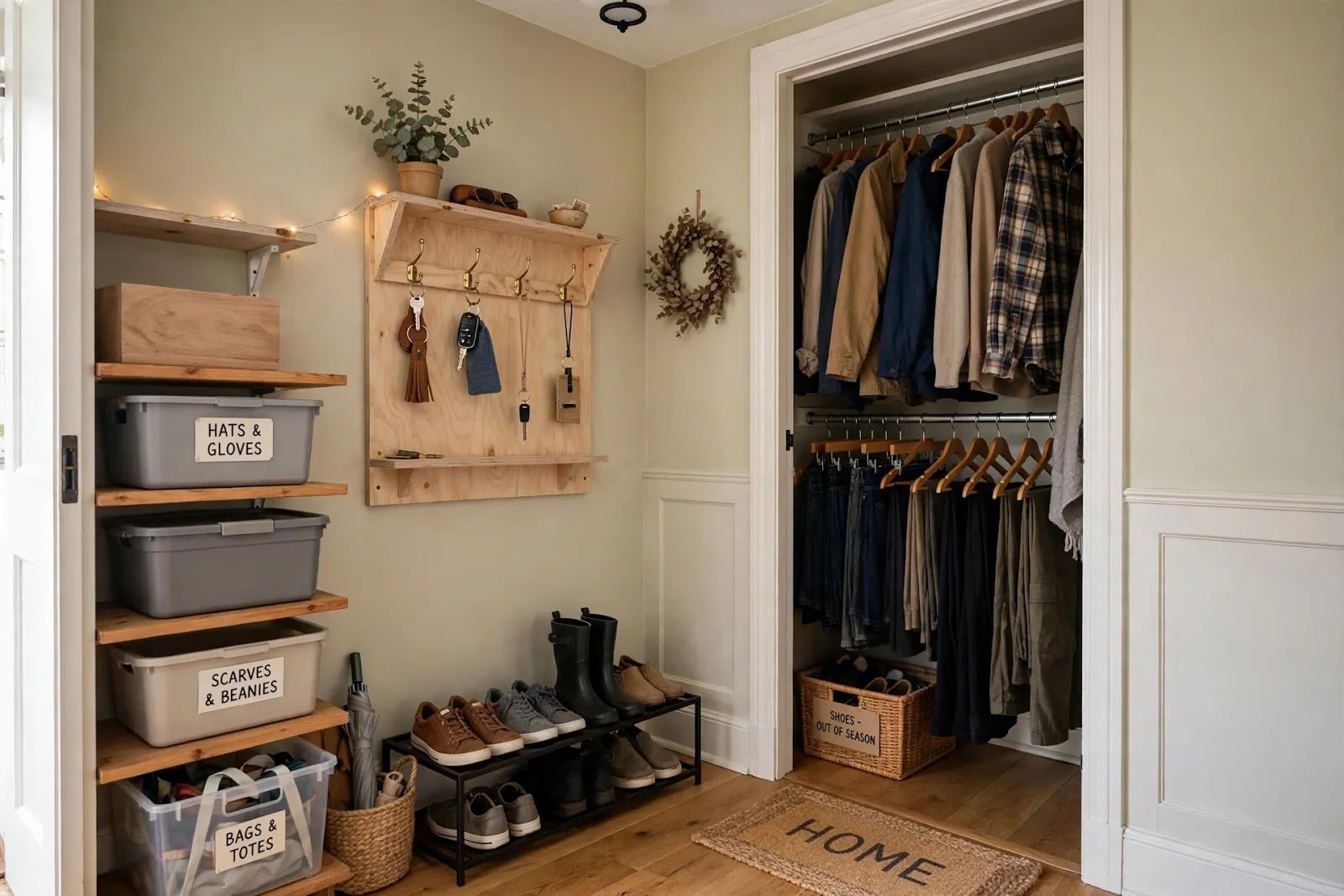
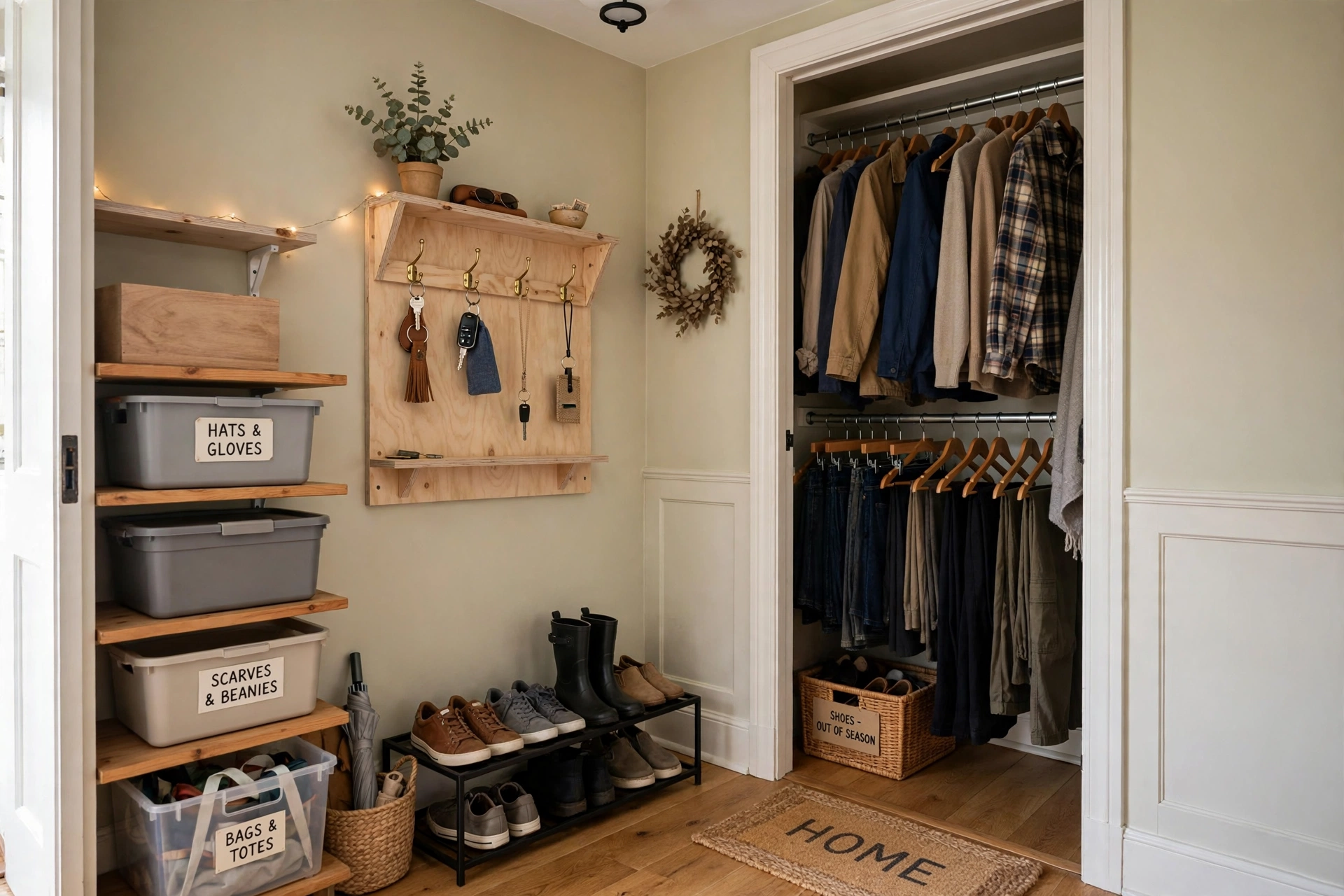
Key/mail organizer ($15–$20) + shoe tray ($10). One hook per person. A command center only works if it sits exactly where you stop when you walk in — within arm’s reach of the door, not across the room. Mount a key and mail organizer at eye level, about 60 inches from the floor, and set a boot tray underneath that is at least 30 inches wide so two pairs of shoes fit without stacking. Give every person one hook and one small basket; when the basket is full, something has to leave. The mistake to avoid is making the entryway a dumping ground for things that belong elsewhere — keep a small “goes upstairs” bin there and empty it every evening. A $15 wall-mounted organizer with three hooks and a $10 rubber boot tray with a raised edge will catch wet shoes and mud, and a tiny dish for coins and sunglasses keeps the flat surfaces clear. If your entryway is a hallway with no wall space, a narrow 12-inch-deep console table does the same job.3. One Bin Per Category ($20–$35)
Broad categories in labeled bins. Label everything — unlabeled bins become junk drawers. Choose broad categories first — “cleaning,” “batteries and tools,” “gift wrap” — and use one bin per category, not one bin per item. Clear 12-quart bins work best on shelves because you can see inside without pulling them down, while opaque fabric bins look calmer in open living spaces. Measure the inside of your shelf before you shop: a standard 12-inch-deep shelf fits a 10-inch-deep bin with room to pull it out. Label the front, not the top, with a $5 label maker or painter’s tape and a marker, and use the same label style everywhere so the system reads as one system. The mistake to avoid is the junk drawer in disguise — if a bin has no label, it becomes one within a month. One bin per category, $20 to $35 for a set of four, and a 15-minute sort is all it takes.4. Closet Double-Hang ($15–$25)
Rod doubler ($12–$18) doubles space. Vacuum bags ($8) for off-season under bed. A rod doubler hangs from your existing closet rod and adds a second rod about 40 inches below it, instantly doubling hanging space for shirts, blouses, and folded pants — no drilling, no carpenter. Measure your closet’s height first: you need at least 72 inches of vertical space for two full rows, and 24 inches of width per row for it to be useful. Vacuum bags ($8 for a set of four) shrink off-season sweaters to a third of their size and slide flat under a bed, but do not vacuum-seal down jackets or leather — the compression damages the fill and the finish. The mistake to avoid is hanging everything: folded knitwear on a shelf lasts longer and frees the rod for things that wrinkle. Add slim velvet hangers, $12 for a 30-pack, and you will fit a third more clothes in the same span. For more space-saving tricks that work in a small home, see this guide to tiny apartment storage.5. Kitchen Zones (Free–$20)
Coffee station, prep zone, cooking zone. Free reorganization beats gadgets. A zone is a job, not a place: the coffee station holds the mugs, the beans, and the machine within one arm’s reach of the outlet; the prep zone keeps the cutting board, knives, and mixing bowls beside the counter where you actually chop; the cooking zone keeps spatulas, oil, and spices within two steps of the stove. Stand in each spot and reach — if you have to cross the kitchen for the thing you use every day, the zone is wrong. Free reorganization beats gadgets every time, but a $12 bamboo drawer divider and a $15 turntable for the spice cabinet will make the zones stick. The mistake to avoid is storing by category instead of by use: baking sheets belong near the oven, not with the mixing bowls across the room. Spend 30 minutes moving things, cook one dinner, and adjust anything you reached for twice. For a deeper dive into the kitchen, see these small kitchen organization ideas.6. Bathroom Caddy Per Person ($8–$15)
Each person gets a caddy; counter stays clear. Under-sink organizer ($12). Give each person a caddy they can carry — a $10 plastic shower caddy or a small handled basket — and keep only the daily essentials inside: toothbrush, deodorant, moisturizer, and one styling product. Everything else lives in the cabinet, not on the counter. Under the sink, a $12 two-tier organizer with a pull-out drawer works around the pipes; measure the space around the drain trap first, because a 14-inch-wide organizer will not fit a 12-inch gap. The mistake to avoid is the shared pile: when four people’s products share one shelf, nobody can find anything and the counter fills up again within a week. Wipe the counter nightly and keep a small lidded bin for empties — when it is full, it is time to restock, not to buy more.7. Paper Station ($10–$20)
3-slot sorter: Action, File, Recycle. Photograph receipts, recycle paper. Paper only piles up when it has no decision attached to it. Set up a three-slot sorter by the door you come in through: Action for bills and forms due this week, File for documents you must keep, and Recycle for everything else. Photograph receipts with your phone the day they arrive, then recycle the paper — a $10 desktop file box with hanging folders holds a year’s worth of the keepers. Process the Action slot every Sunday for 10 minutes, and never let it hold more than five items. The mistake to avoid is the “I’ll deal with it later” pile on the kitchen counter; paper left there becomes invisible within a day. A wall-mounted sorter ($12 to $18) keeps the counter clear and the system visible to everyone in the house.8. Donation Station ($0–$10)
One bag in a closet. When full, drop off. 12 bags a year, no declutter day. Keep one sturdy bag — a reusable shopping tote or a 13-gallon trash bag — hanging on a hook inside a closet, and drop things into it the moment you decide you no longer need them. No sorting session, no guilt, no “maybe later” box in the garage. When the bag is full, it goes straight to the car, and the next time you drive past a donation drop-off, it goes in. Twelve bags a year is one bag a month, and most homes can fill one without trying. The mistake to avoid is the donation pile that never leaves: if the bag sits by the door for more than a week, you will start pulling things back out of it. Set a rule — a full bag leaves within 48 hours — and keep the bag in a closet, not in the living room, so it never becomes decor.9. Toy Rotation ($10–$20)
Store 80%, rotate monthly. Old toys feel new again. Store about 80 percent of the toys in labeled bins on a high closet shelf or under the bed, and leave out only what fits on one low shelf your child can reach. Once a month, swap the shelf: the stored toys feel brand new, and the ones that were out go back into rotation. A $15 set of clear bins with lids makes the swap a 10-minute job, and a small basket by the door catches the toys that migrate around the house each evening. The mistake to avoid is keeping everything visible at once — a wall of toys overwhelms a child and guarantees a mess, no matter how many bins you buy. If a toy has not been chosen in two rotations, it goes in the donation bag. Keep the rotation simple: same day each month, same shelf, same 10 minutes.10. Nightly Reset (Free)
10 minutes: dishes, counters, tidy, entryway. Prevents the Saturday avalanche. Set a timer for 10 minutes every evening: dishes into the dishwasher, counters wiped, toys back in their bins, shoes in the entryway tray, and tomorrow’s bag by the door. It is not cleaning — it is resetting, and the difference matters, because a reset has a finish line. Do it at the same time every night, right after dinner, so it becomes a habit instead of a decision. The mistake to avoid is the Saturday avalanche: skip the reset for three nights and you will spend two hours on Saturday recovering a house that took 30 minutes to maintain. A $0 habit with a $0 price tag, and it is the system that makes the other nine work — an organized home is just a home that gets reset every night.FAQ
Where do I start?
One zone — entryway or one drawer. Finish it completely, then move on. The entryway is the best first zone because you see the result every time you come home, and a single drawer takes under 20 minutes. Do not start with the garage or a whole room — a small, finished win teaches you the system faster than a big, half-finished project. Once one zone works for two weeks without thinking, pick the next one.Cheapest way to organize?
Free systems first: homes for everything, kitchen zones, donation bag, nightly reset. Start with the free systems and only buy bins after you know what each bin must hold. A $20 set of four clear bins is the only purchase most homes need in the first month, and a $5 label maker makes them look intentional instead of improvised.With kids?
Reachable bins, toy rotation, nightly reset as a family timer game. Give every child one reachable bin for their own things, rotate toys monthly, and turn the nightly reset into a 10-minute family timer game with a small reward — a story, a song, or choosing tomorrow’s breakfast. Systems kids can reach are systems kids will actually use.✨ You may also love:
📚 Love these ideas? Get the complete book!
This article is just a taste! My 123-page eBook “Budget Decor, Big Style” covers every room of your home — with budget tables, step-by-step room recipes, checklists and pro secrets that make any home look expensive, for less.
Use code LAUNCH30 for 30% OFF 🎉
As an Amazon Associate I earn from qualifying purchases. Some links in this article are affiliate links — if you buy through them, we may earn a small commission at no extra cost to you.


One Comment