Small Spice Organization: 9 Ideas for Tiny Kitchens
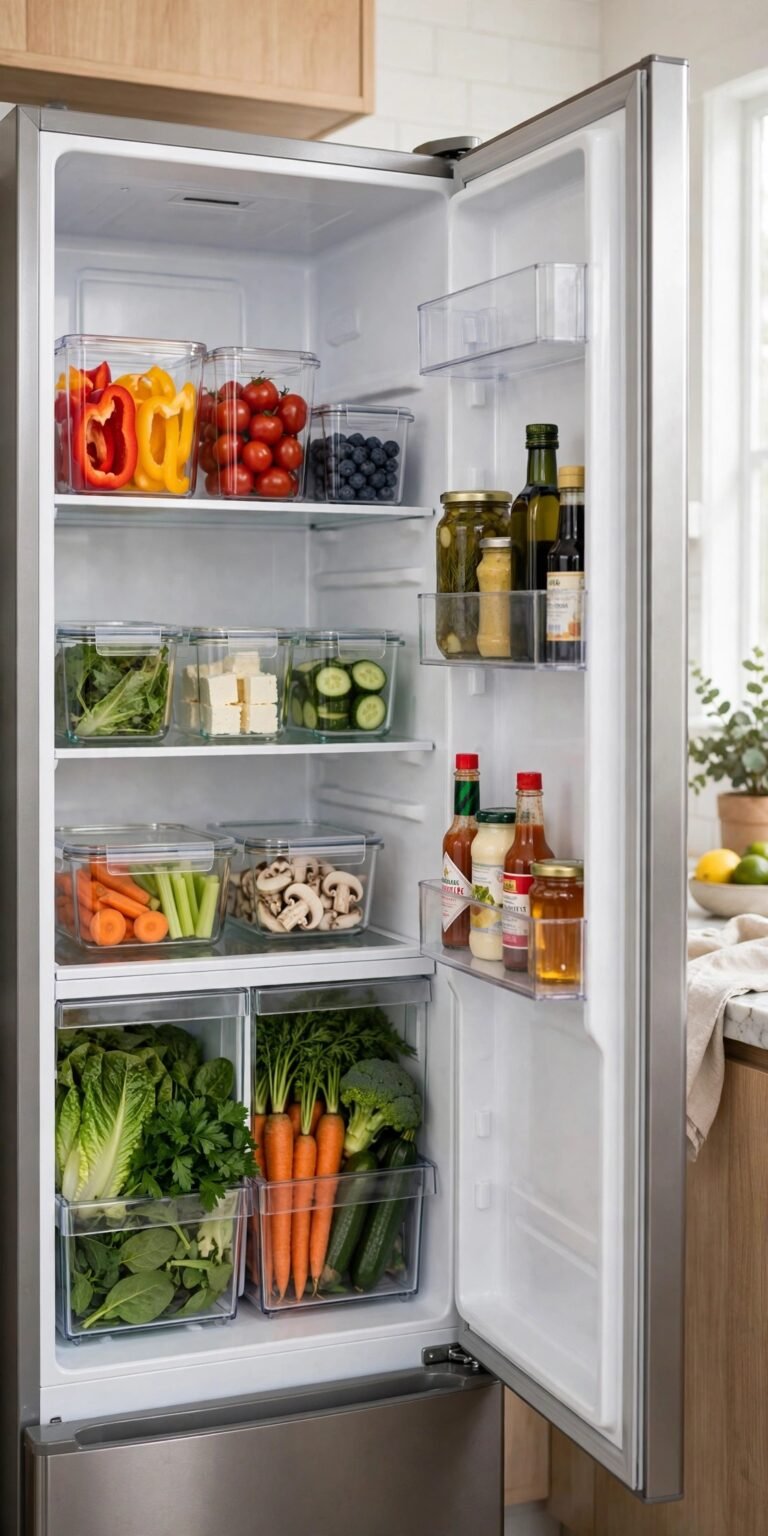
A small kitchen loses its spices twice: first to the back of the cabinet, where jars hide and expire unseen, and then to the counter, where the six jars you actually use take up the only workspace you have. The fix is not a bigger kitchen — it is giving every spice one home, within arm’s reach of the stove, so you can grab what you need without digging. These nine spice organization ideas do exactly that, and none of them needs a remodel. Cold storage needs the same treatment, so start with this fridge organization for small kitchens.
1. Audit the Spice Collection First
No organization system survives a collection full of duplicates and dead jars. Pull every spice out of the cabinet, check the dates, and throw away anything stale, faded, or older than a year — ground spices lose their flavour long before they look bad. Merge duplicates into one jar and write down the five or six spices you actually cook with every week.
The audit matters because most small kitchens are storing twice as many spices as they use. Once the dead jars are gone, the collection fits in one place, and the system you build is sized for real life instead of for a spice shop. A ten-minute audit is the cheapest square footage you will ever gain in a tiny kitchen.
2. One Home for Every Spice
Spices fail when they live in three places: some in the cabinet, some on the counter, some in a box on top of the fridge. Pick one home — one cabinet shelf, one drawer, or one rack — and move the whole collection there. If a spice cannot fit in the chosen home, it does not earn a place in the kitchen at all.
One home works because cooking is fast and repetitive: you reach for the same spot every time, without thinking. When the paprika always lives on the second shelf, you never hunt for it mid-recipe. A single home also makes the weekly shop obvious — an empty spot means a spice needs buying, not a guess.

3. Lay Them Flat in a Drawer
A shallow kitchen drawer is the best spice home a tiny kitchen has, and most people never try it. Lay the jars flat in a single layer with the labels facing up, or fit a simple drawer insert that tilts each jar toward you. Every label is visible the moment you open the drawer, and nothing hides behind anything else.
Flat storage works because a drawer is a top-down view — you see the whole collection at once, like a spice chart. It also frees the cabinet above for taller things and keeps the counter completely clear. If you only make one change, make it this one: the drawer beats every rack for speed.
4. Use the Inside of the Cabinet Door
The inside of a cabinet door is free storage that most kitchens waste. A slim door-mounted rack, a row of small adhesive hooks, or a magnetic strip on the door holds the six everyday spices — salt, pepper, paprika, cumin, chilli flakes, garlic powder — right where you cook, without taking a single centimetre of shelf space.
Door storage works because the door is already there and already empty. Keep the rack shallow so the door still closes, and keep it to the everyday six: the door is for the spices you grab with one hand while stirring, not for the whole collection. The rest of the spices live in the drawer or the cabinet, one step away.
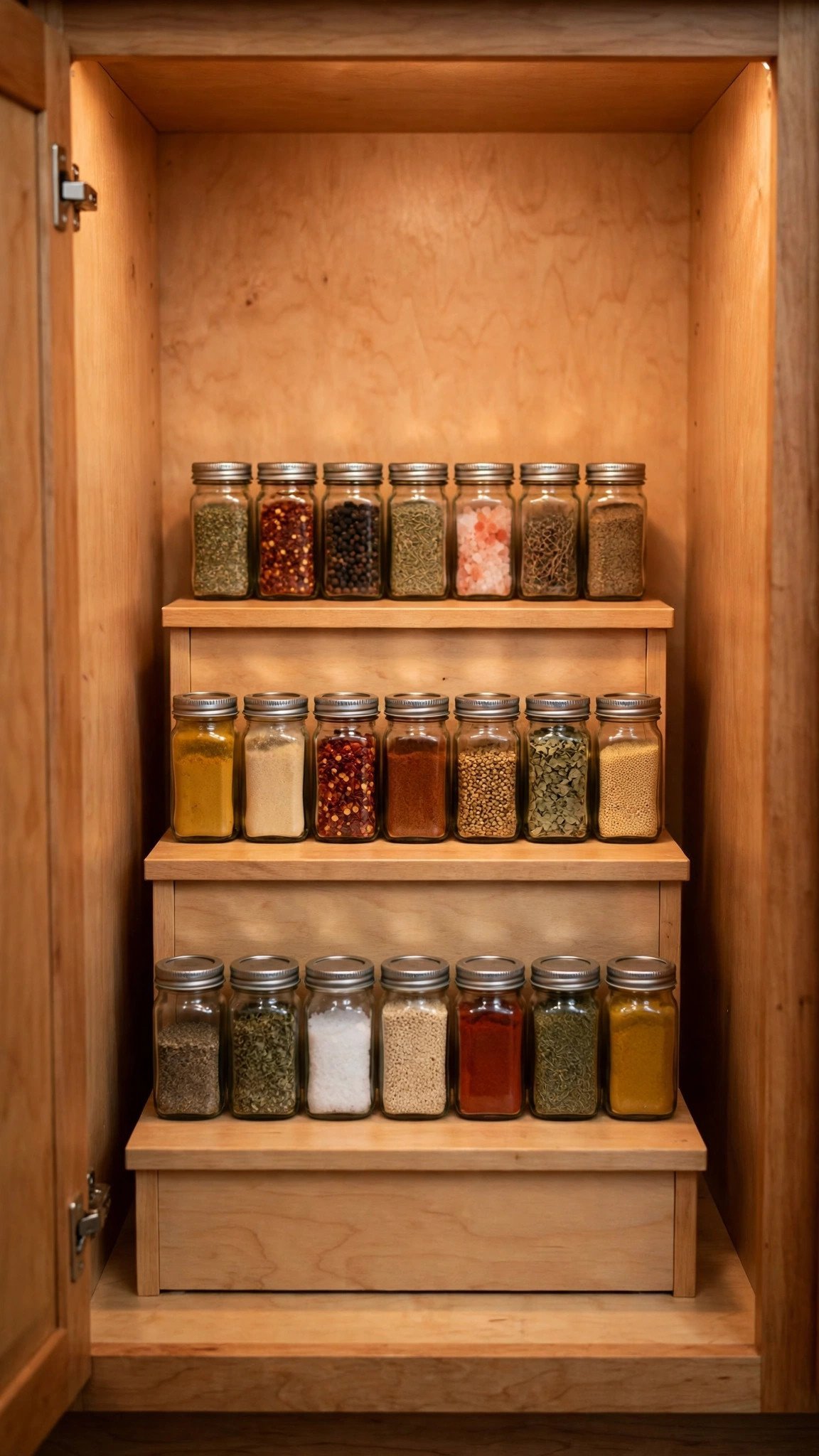
5. Add a Tiered Shelf Riser
A single cabinet shelf wastes half its height: one row of jars in front hides a second row behind it. A small tiered riser — two or three steps, like stadium seating — lifts the back rows up so every label is visible from the front. A riser costs almost nothing and doubles the usable shelf in an afternoon.
Tiered shelves work because visibility is the whole problem with spices: a jar you cannot see is a jar you will buy twice. With the back row raised, you scan the shelf once and find what you need. Measure the shelf height first so the tallest jar still fits under the shelf above.
6. Go Magnetic on the Fridge Side
The side of the fridge is a blank wall in most small kitchens, and magnetic spice jars turn it into storage. Small tins with clear lids stick to the fridge side in a neat grid, labels facing out, at exactly the height you reach for while cooking. The same trick works on any magnetic strip mounted on the wall beside the stove.
Magnetic storage works because it uses a surface that was doing nothing, and it keeps the spices visible and reachable. Keep the tins small and the set to the spices you use weekly — a fridge side full of thirty tins is a display, not a system. Ten everyday spices on the fridge, the rest in the drawer, is the right split. The same visibility rule fixes the cupboard too, so try these pantry organization ideas.

7. Decant Into Matching Jars and Label Them
Mismatched jars are what make a spice shelf look chaotic: tall, short, round, square, half of them with faded supermarket labels. Decant the spices you use into one set of matching small jars with tight lids, and label every jar on the lid and the side with the name and the date you filled it.
Matching jars work because uniform size stacks and lines up neatly, so the shelf holds more and looks calmer. Labels matter twice: on the side for the shelf, on the lid for the drawer. A label maker is nice, but masking tape and a marker do the same job for pennies — the point is that every jar can be identified in one second.
8. Fill the Gap With a Pull-Out Rack
Almost every small kitchen has a dead gap — the few centimetres between the fridge and the counter, or beside the stove — that is too narrow for a cabinet and too wide to ignore. A slim pull-out rack on casters slides into that gap and holds a full row of spice jars, rolling out when you cook and disappearing when you do not.
The gap rack works because it turns wasted space into the most-used storage in the kitchen. Build or buy one to fit your exact gap, and load it with the everyday spices so the rack earns its keep daily. It is the one idea on this list that feels like a remodel without costing like one.
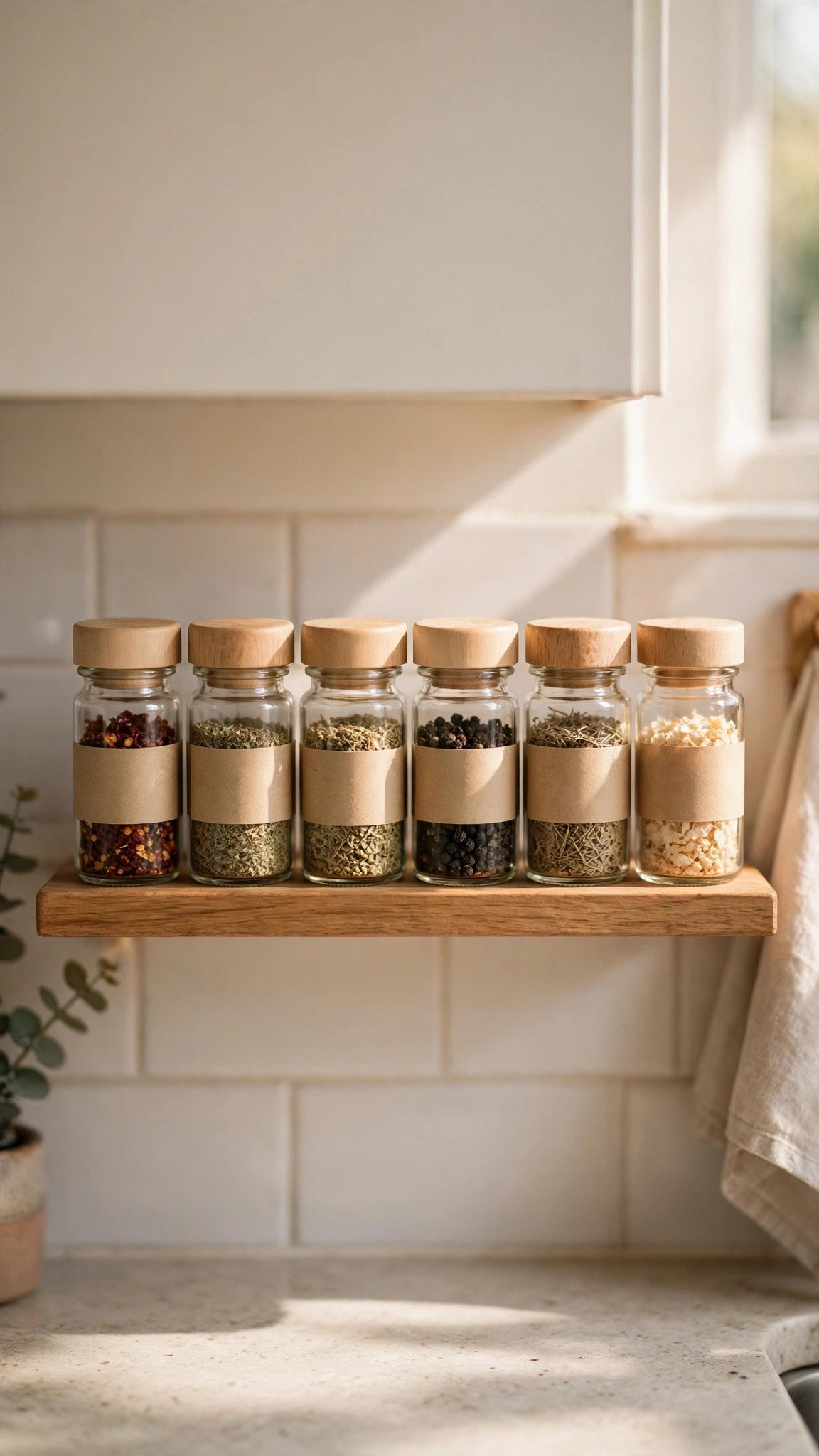
9. Keep Everyday Spices by the Stove, the Rest Away
Not every spice deserves the prime spot. Keep the six you use every week within arm’s reach of the stove — the door rack, the magnetic strip, or the front of the drawer. Move the once-a-month spices — the whole nutmeg, the saffron, the smoked paprika you bought for one recipe — to a labelled box on a higher shelf.
The split works because prime space is the scarcest thing in a tiny kitchen, and spending it on a spice you touch twice a year is a waste. The everyday six stay fast and visible, the occasional spices stay findable in their one box, and the cooking zone stays clear. When a spice earns weekly use, promote it to the stove; when it stops, demote it to the box.
A Spice Collection That Cooks With You
None of these ideas needs a bigger kitchen or a big budget. Audit the collection, give every spice one home, lay the jars flat in a drawer, use the cabinet door, raise the back row with a riser, go magnetic on the fridge side, decant into matching labelled jars, fill the gap with a pull-out rack, and keep the everyday six by the stove. Start with the audit and the drawer — the two cheapest moves — and the spice hunt ends, because every jar finally has one clear place to be. Once the spices are sorted, the counters feel bigger too, as shown in this small kitchen counter organization.