Small Kitchen Organization Ideas: 10 Ways to Double Your Space on a Budget
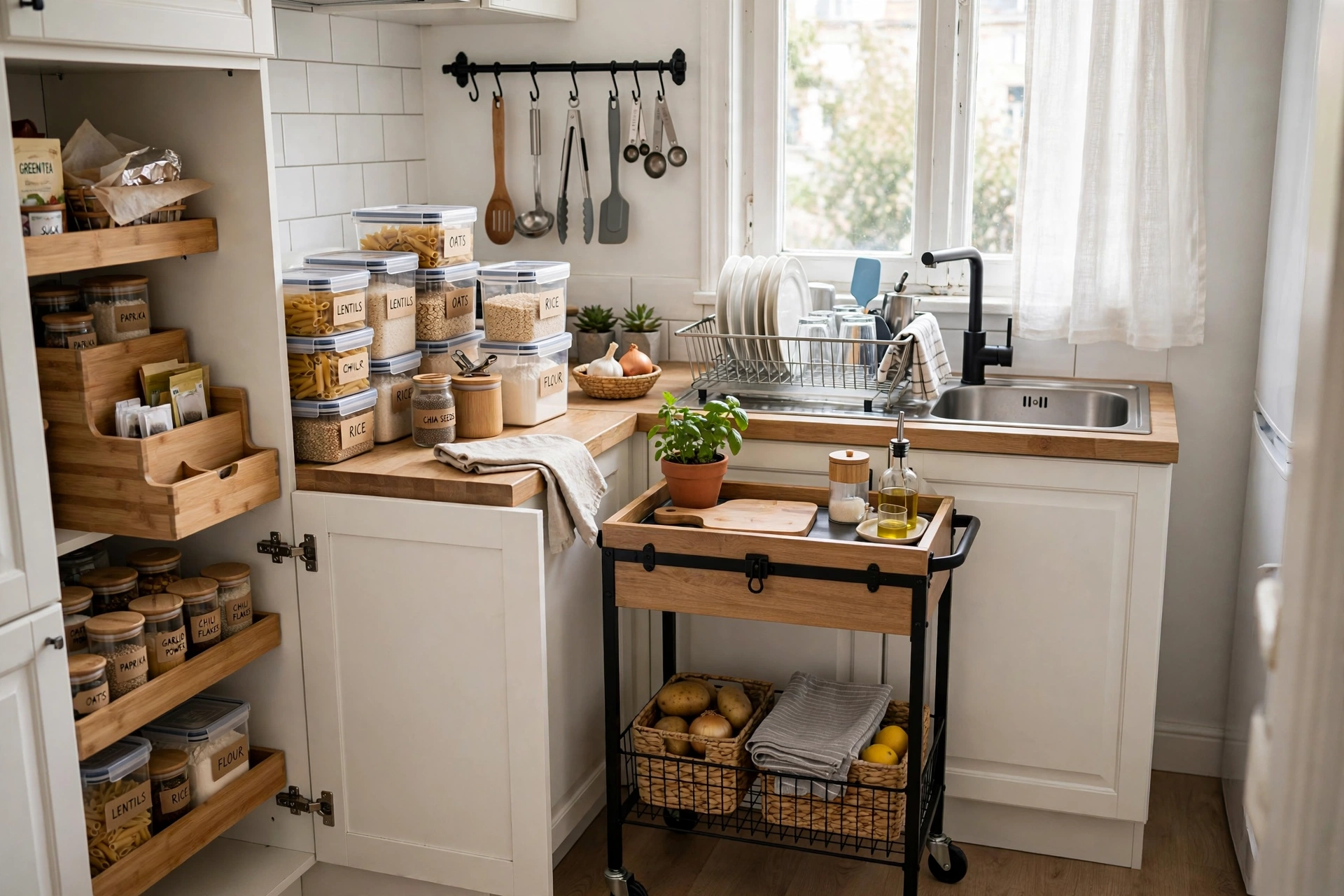
A small kitchen is not a storage problem — it is a placement problem. Everything you own probably fits; it is just all fighting for the same three drawers. These small kitchen organization ideas are cheap, renter-friendly, and honest: no remodel, no matching container set you have to buy first, just the right things in the right places. For more hardware that adds real space, see these small kitchen storage ideas.
As an Amazon Associate I earn from qualifying purchases. Some links in this article are affiliate links — if you buy through them, we may earn a small commission at no extra cost to you.
1. Clear the Counters First — All of Them
Counter space is work space, and in a small kitchen it is the scarcest thing you own. Take everything off, then put back only what you use every single day — the kettle, maybe the knife block. The toaster, the blender, the bread box: they earn a cabinet spot, not permanent counter rent. An empty counter makes the whole kitchen feel twice the size before you organize a single drawer.
Leave only three things on the counter: the kettle, the knife block, and one daily-use item. Everything else earns its spot by daily use — if you have not touched the toaster in a week, it lives in a cabinet. A clear counter wipes clean in 30 seconds; a crowded one takes five minutes. You need at least 60 centimetres of clear counter to chop. For more ways to keep counters clear, see this guide to small kitchen counter organization.
2. Use the Inside of Every Cabinet Door
Cabinet doors are free storage hiding in plain sight. Slim stick-on racks hold pot lids and cutting boards; small hooks take measuring spoons and oven mitts; a narrow caddy swallows cling film and foil boxes. One door can free an entire drawer — and doors need no tools and leave no holes, so renters are safe.
Stick the rack to a clean door: wipe it with sugar soap first, or grease kills the adhesive within days. Measure the door’s inside depth before you buy — a rack deeper than 5 centimetres stops the door closing. Load the door with light things only: lids, boards, measuring spoons. Keep the total door load under 1 kilogram, or the hinges sag.

3. Turn One Shelf Into Two With Risers
Most kitchen cabinets waste half their height: short jars on a tall shelf, air above them. A simple wire shelf riser doubles the surface instantly — mugs below, bowls above. It is the cheapest square footage you will ever buy, usually under ten dollars, and it works in every cabinet you own.
Measure the gap before you buy the riser: a riser 20 centimetres tall fits a 30-centimetre shelf gap, while a 25-centimetre riser in the same gap turns the shelf into a lid. A 25-centimetre-wide riser fits a 30-centimetre cabinet; a 28-centimetre one jams. A wire riser rated for 5 kilograms bows under 8 stoneware dinner plates. Keep the riser for everyday dishes, not the once-a-year serving platter.
4. Divide the Drawers or Lose Them
An undivided drawer is a junk drawer waiting to happen. Cheap bamboo or plastic dividers turn one chaotic drawer into six calm sections — cutlery, utensils, wraps, tools. The rule is simple: if you cannot see it in two seconds, it does not have a section yet. Two seconds is the standard for everything in this kitchen. For the drawer that defies all dividers, see this guide to junk drawer organization for a small kitchen.
Measure the drawer before you buy dividers: a standard kitchen drawer is 45 centimetres wide, but older drawers vary. Adjustable bamboo dividers cost $12 to $20 for a set and expand to fit. Give the can opener its own slot so you stop emptying the drawer to find it. Line the drawer with a $4 non-slip mat so the dividers do not slide.

5. The Wall Is Free Storage
A simple rail with hooks holds the utensils and pans you reach for daily, and a magnetic strip takes the knives. Every item on the wall is an item out of a drawer. Keep it to the daily tools only — a rail crowded with twenty gadgets is just vertical clutter. Five hooks, five heroes.
Fix the rail with screws into studs, not adhesive alone: a rail holding 6 pans and a knife strip carries 8 kilograms, and adhesive alone fails within weeks. A 60-centimetre rail costs about $15; a 90-centimetre rail holds the pans and the utensils too. Hang the heaviest pan nearest the wall bracket, not at the end, or the rail sags over time. Keep 45 centimetres clear above a knife strip, or the knives hit the shelf.

6. Go Vertical: Stack, Nest, Hang
Small kitchens grow upward or not at all. Stackable clear bins corral packets and snacks; nesting bowls and measuring cups halve their footprint; a tension rod under the sink becomes a hanging rail for spray bottles. Clear beats cute here — you should see what you have at a glance, or you will buy it again.
Stack no more than 3 bins high: a fourth bin makes the stack wobble, and the top bin falls when you pull the middle one. Label clear bins on the front, not the lid, so you can read them on the shelf. Nest mixing bowls by size, largest at the bottom. Put the bins you open daily at eye level, and the once-a-month bins on the top shelf.
7. Decant the Dry Goods Into Uniform Containers
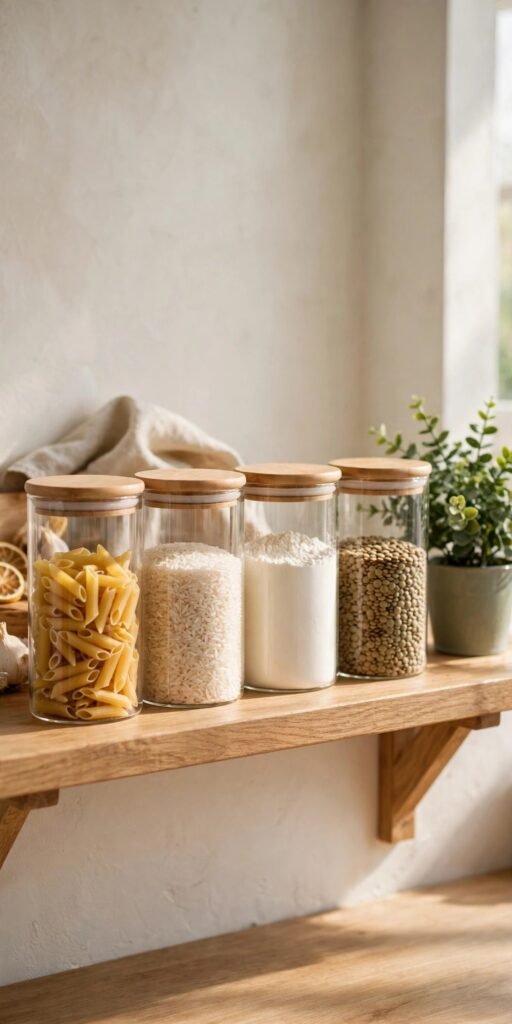
Half-empty bags and mismatched boxes waste space and hide what you own. Uniform square containers of rice, flour, pasta and lentils stack like bricks with zero wasted corners, and you can see at a glance what is running low. Start with the five things you use most — you do not need the full matching set on day one.
Buy square containers in one size: a 1-litre square jar holds about 800 grams of pasta. A 30-centimetre shelf fits four 1-litre jars side by side. Glass jars with bamboo lids cost $10 to $15 for a set of 3 and seal better than snap lids. Decant only what you use weekly. Write the expiry date on the base, not the front, so the label stays clean.
8. Claim the Forgotten Gaps
Every small kitchen has dead space: the sliver between fridge and wall (a slim rolling trolley lives there), the area over the sink (a dish rack or shelf bridges it), the dark gap above the cabinets (long-term storage in labeled bins). Measure your gaps before you shop — the right trolley is the one that fits your exact sliver.
A slim trolley 15 centimetres wide fits the gap between most fridges and walls. Measure the gap at the top and the bottom — floors slope, and a trolley that fits at the top can jam at the bottom. A $20 trolley with 3 tiers holds oils, spices, and cleaning sprays. Put the heaviest bottles on the bottom tier, or the trolley tips when you pull it out.
9. Store by Frequency, Not by Category
Daily plates and glasses at arm’s reach, at eye level. The waffle maker and the holiday platter go up high or down low, where bending is rare. Most kitchens are organized by what things ARE; small kitchens must be organized by how OFTEN they are used. Rearranging by frequency costs nothing and changes everything.
Run the 3-month test on the middle shelf: anything you have not touched in 3 months moves to the top shelf or the lowest one the same day. The middle shelf is prime space — it should hold only the plates, glasses, and mugs you use every day. If the middle shelf is full, something on it does not belong there.
10. The 15-Minute Nightly Reset
Organization is not a project, it is a habit — and the habit is small. Fifteen minutes after dinner: counters wiped and cleared, dishes out of the sink, everything back to its section. A small kitchen forgives a busy day but not a skipped week. The reset is what keeps all nine ideas above working in February, not just this weekend.
Set a timer for 15 minutes and stop when it rings — a reset that drags on for an hour is a reset you will skip tomorrow. Start at the sink every night and work in one direction. Keep a small donation box by the door for the things the reset turns up: the chipped mug, the lid with no pot, the gadget you never use.
Bonus: Four More Budget Buys From Our Earlier Guide
When we first covered small-kitchen organization, readers asked for the exact buys and prices, so here are the four that did not make the ten ideas above. Start free: empty every cabinet and drawer, toss expired spices and duplicate gadgets, and let go of anything you have not used in six months unless it is seasonal.
- Over-the-sink dish rack ($25–$35): a roll-up rack ($20–$30) sits over the sink and disappears when you are done, and a $15 over-the-sink shelf rack adds a whole extra counter above a tiny sink.
- Hang the pots ($20–$40): a wall-mounted pot rail ($20–$30) or a ceiling rack ($30 and up) gets bulky pots out of the cabinets; renters can use a freestanding pot rack (about $25) with no holes in the wall.
- Coffee station tray ($10–$15): a $10–$12 tray or basket corrals the coffee maker, mugs, and sugar into one movable station, and the same trick works for cooking oils and spices beside the stove.
- Rolling cart as a flexible island ($30–$45): a rolling cart such as the IKEA RASKOG (about $30) is a prep surface, pantry overflow, and serving trolley in one; in a galley kitchen, a $35 fold-down wall table doubles as a breakfast bar and prep surface.
The under-$100 total: wall rail about $15, adhesive hooks $8, dish rack $25, shelf risers $15, clear containers $20, and chalk-marker labels $5 — roughly $88–$94 for the whole reset, before you count the free habits (declutter first, zone the kitchen, and the 15-minute nightly reset above).
Quick answers: no pantry? Go vertical and use the hidden spots — inside cabinet doors, over the sink, and the gap beside the fridge. Renting and cannot drill? Adhesive hooks and racks, tension rods, and freestanding or over-sink pieces leave no marks. Cheapest counter space? Clear it first, then add an over-sink rack (about $25). Keeping it organized? One item in, one item out, a five-minute nightly reset, and a ten-minute declutter once a month.
Small Space, Same Kitchen, Half the Stress
You do not need a bigger kitchen — you need the kitchen you have, arranged by someone who cooks in it. Start with the counters and one drawer this weekend, add a riser and a door rack next week, and let the nightly reset hold the line. Small, calm, and everything in two seconds’ reach: that is the whole goal.
✨ You may also love:
- Small Kitchen Storage Ideas: 10 Clever Ways to Gain Space
- Pantry Organization Ideas: 10 Budget Systems for a Tidy Kitchen
- Home Organization Ideas on a Budget: 10 Systems That Actually Stick (2026 Guide)
📚 Love these ideas? Get the complete book!
This article is just a taste! My 123-page eBook “Budget Decor, Big Style” covers every room of your home — with budget tables, step-by-step room recipes, checklists and pro secrets that make any home look expensive, for less.
Use code LAUNCH30 for 30% OFF 🎉