Small Home Office Organization: 8 Ideas for Tiny Workspaces
A small home office fails for one reason: everything in it has to share the same square metre, so the laptop, the papers, the chargers and the coffee all end up in one pile. The fix is not a bigger room — it is giving every single thing one clear home, so the desk is a desk again instead of a storage shelf. These eight small home office organization ideas do exactly that, and none of them needs a remodel or a big budget. The same zone logic works at the front door too, so start with this entryway organization for small homes.
1. Give Everything a Zone
A tiny workspace only works when it has zones, not piles. Split the desk into three small areas: a work zone for the laptop and keyboard, a paper zone for the notebook and the one folder you actually use, and a charging zone for the phone and cables. Nothing crosses its border.
Zones work because they stop the slow spread. When the charger lives in its zone, it never ends up on top of the keyboard. When papers live in their zone, they never bury the mouse. Draw the zones once — a tray, a small mat, a corner of the desk — and the desk stays a workspace instead of turning back into a junk drawer.

2. Go Vertical With Shelves and a Pegboard
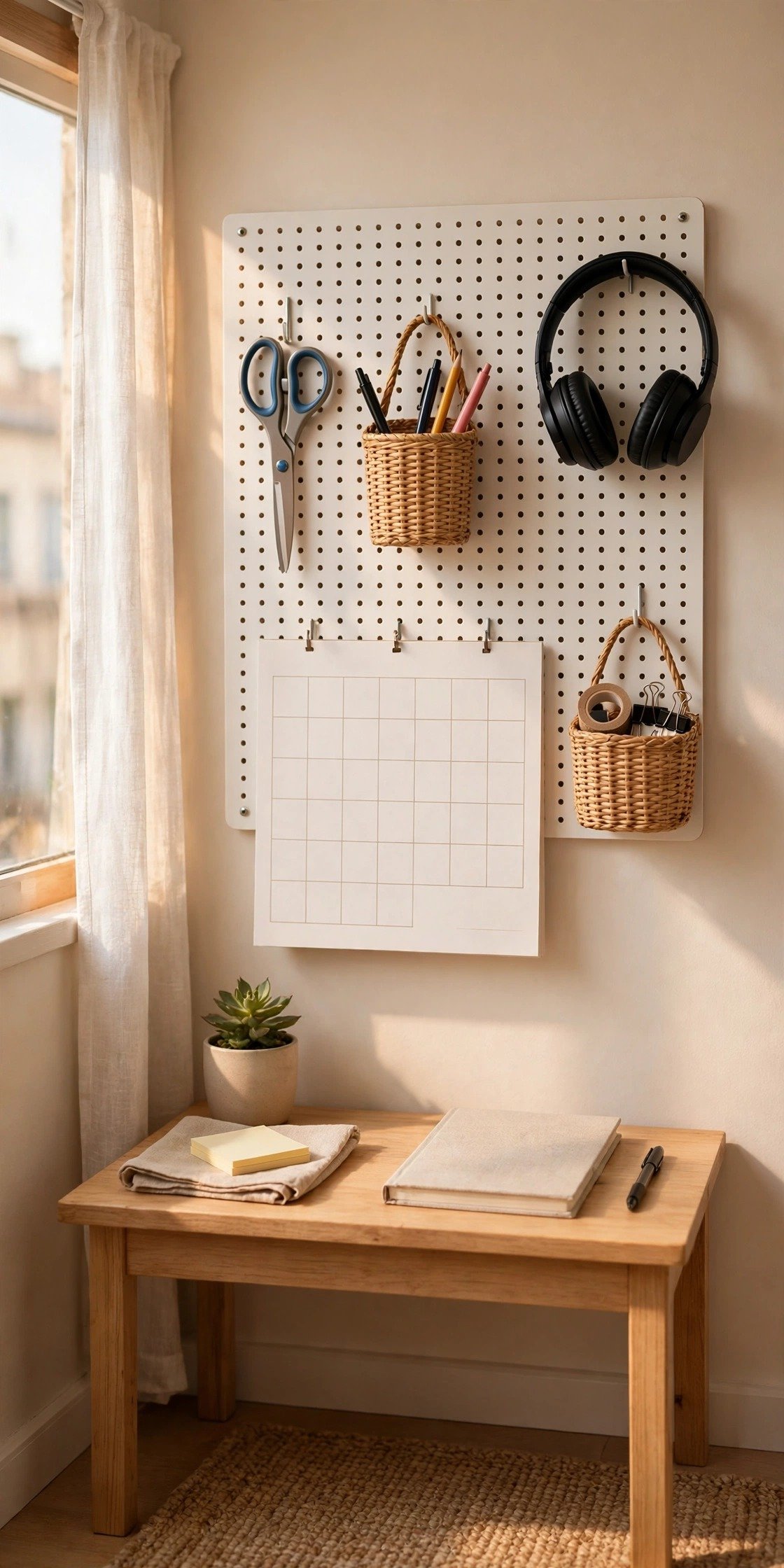
Desk space is the scarcest thing in a small home office, so storage belongs on the wall. A floating shelf above the desk holds the books and the plant, and a small pegboard holds scissors, pens, headphones and the tape — everything visible, everything one reach away.
When storage goes up, the desk stays clear, and a clear desk is what makes a tiny workspace feel calm instead of cramped. The rule is simple: if it can hang on a wall, it does not sit on the desk. One shelf and one pegboard free up more desk space than any drawer organizer ever will.
3. Pick a Desk That Folds Away
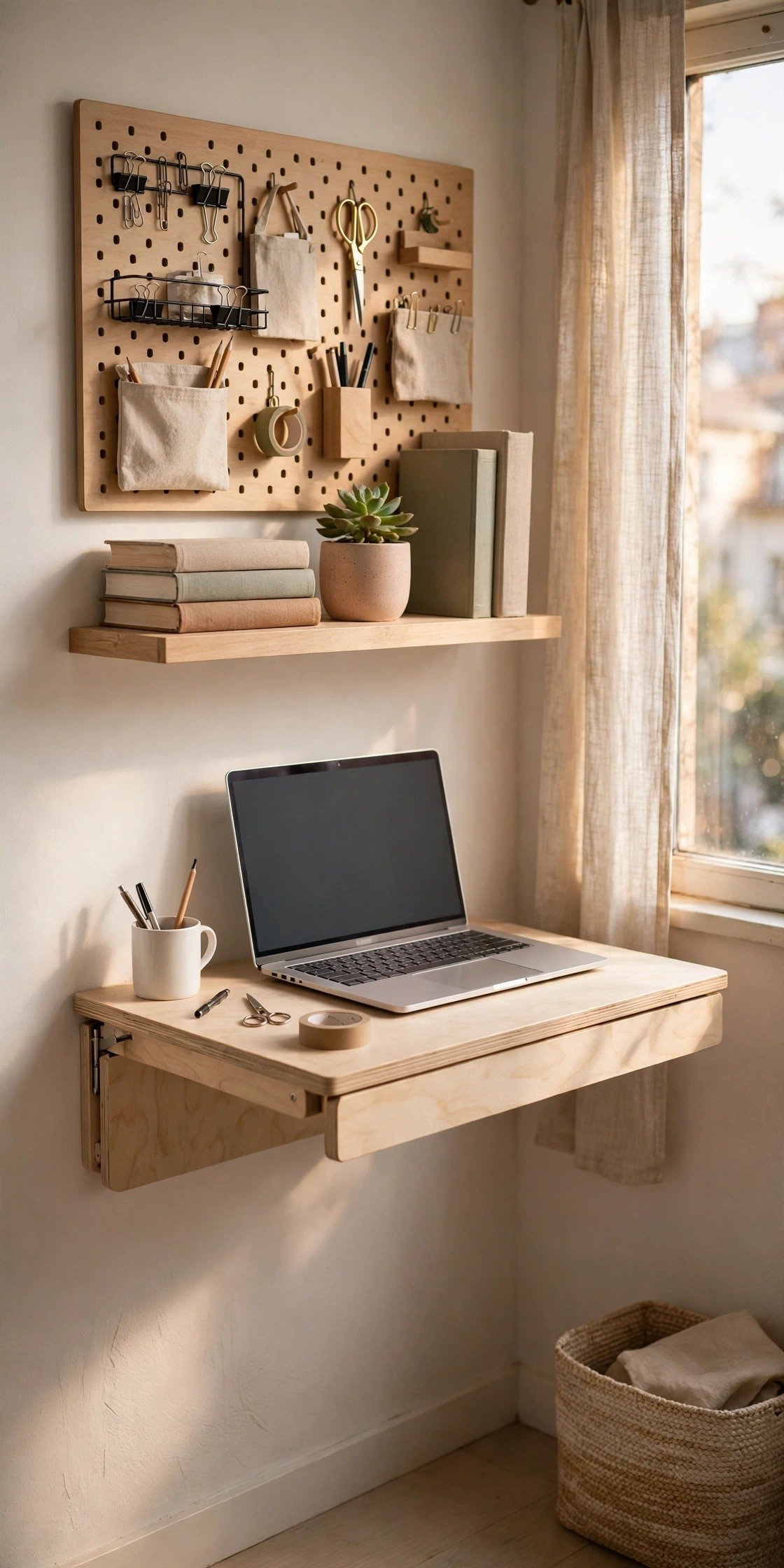
In a tiny home, the office often shares a room with the living room or the bedroom, so the desk has to disappear when work ends. A wall-mounted fold-down desk or a narrow console that slides against the wall gives you a real work surface at 9am and your room back at 6pm.
The fold-away desk works because it enforces the reset: you cannot leave a mess on a desk that has to fold up. Everything gets put away every evening, and the room stops feeling like an office after hours. If a fold-down desk is too much, even a laptop stand that lifts the screen off a side table does the same job on a smaller scale.
4. One Inbox Tray, Not Five Piles
Paper is what kills a small desk, because one sheet becomes a pile within a day. Keep exactly one inbox tray on the desk — everything incoming goes in it, and nothing else is allowed to stack. Bills, letters, school forms: all in the tray, nowhere else.
Once a week, empty the tray completely: file it, act on it, or throw it away. One tray is easy to clear; five mystery piles are not. The tray is not storage, it is a waiting room, and a waiting room that never empties is just a pile with a prettier name.

5. Tame the Cables
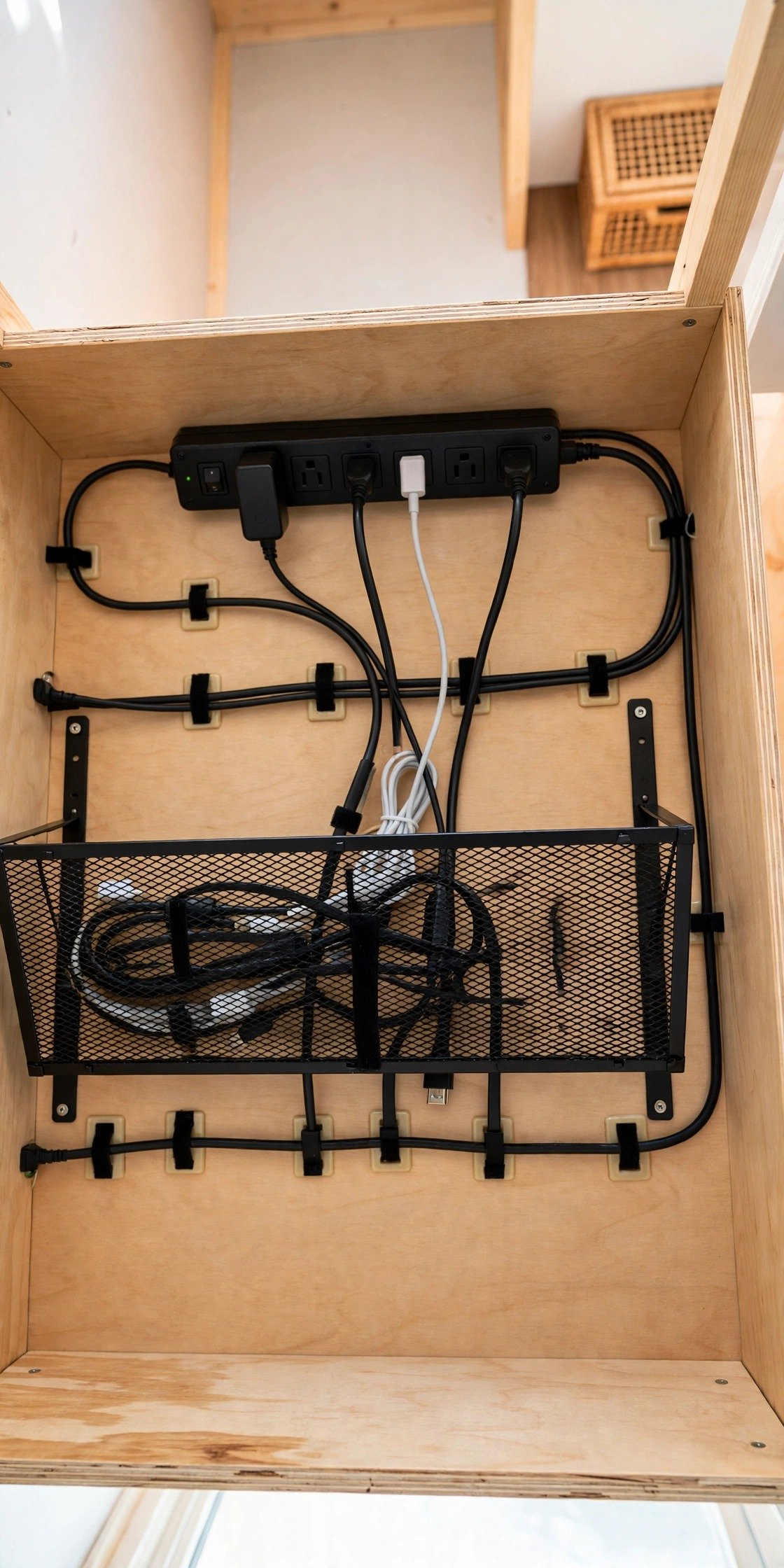
Nothing makes a tiny workspace look messier than cables. One power strip behind the desk, a small cable tray or a few adhesive clips under the desk edge, and every cable has a route instead of a tangle. Label the plugs with a strip of tape so you never unplug the wrong thing.
Cables take two minutes to route and save you from the daily knot. When the cables are hidden, the desk reads as one clean surface, and the whole corner feels bigger. Keep one spare cable in a drawer, not five tangled in a box — one spare is enough.
6. A Rolling Cart as a Sidekick
A small three-tier rolling cart is the best friend a tiny office can have. It holds the printer paper, the notebooks, the spare pens and the snacks, and it rolls under the desk or into a corner when you need the floor. It is storage that moves out of the way.
The cart works because it is the office’s junk drawer, but an organized one: top tier for daily things, middle tier for weekly things, bottom tier for spares. When the cart is full, something has to go — which is exactly the limit a small workspace needs. The same thinking scales to a whole flat, as shown in this tiny apartment storage guide.
7. Label the Drawers
A drawer without a label becomes a mystery box within a week. Label every drawer and every box in the office — even the obvious ones. “Pens”, “Cables”, “Stamps”, “Notebooks”: five seconds with a label maker or a strip of masking tape.
Labels work because they make putting things away as easy as taking them out. When the drawer says what it holds, the thing goes back to the right place instead of landing on the desk. A labelled drawer stays organized; an unlabelled one fills up with everything and nothing.
8. The Five-Minute Shutdown Reset
A small office only stays organized if it is reset daily, and the reset only happens if it is short. Five minutes at the end of the workday: laptop closed and on its stand, papers back in the tray, pens in the pot, mug in the kitchen, desk wiped.
Five minutes beats a weekend-long tidy every single time, and the next morning starts at a clean desk instead of yesterday’s mess. The small workspace feels big because nothing is in the way — and the workday has a proper ending, which is worth as much as the tidy desk.
A Tiny Office That Actually Works
None of these ideas needs a bigger room or a big budget. Zones on the desk, storage up the walls, a desk that folds away, one inbox tray, tamed cables, a rolling cart, labelled drawers, and a five-minute shutdown reset. Start with the zones and the pegboard — the two cheapest moves — and the tiny workspace stops feeling like a squeeze, because everything in it finally has one clear place to be. All of it costs very little, as shown in these home organization ideas on a budget.