Junk Drawer Organization: 10 Ideas That Actually Work in Small Kitchens
Every kitchen has one: the drawer where batteries, rubber bands, spare keys, tape, and three kinds of charger go to disappear. In a small kitchen the junk drawer matters more, because there is no spare drawer to absorb the overflow — when it jams, the whole kitchen feels broken. The fix is not a bigger drawer. It is a drawer with a system, and these ten junk drawer organization ideas build one in an afternoon, with nothing fancier than dividers, small bins, and a ruthless sort. The same zone logic clears the counters too, so start with this small kitchen counter organization.
1. Empty It Completely First
You cannot organize a drawer you cannot see. Pull the drawer out, tip everything onto the counter, and wipe the drawer clean. The empty drawer is the only honest starting point — everything that goes back in has to earn its place, and everything that does not gets a decision right now.
Emptying works because most junk drawers are full of things nobody chose to keep; they just drifted in. An empty drawer also shows you the real size you are working with, which stops you buying organizers that do not fit. Give yourself a clear counter and a bin bag before you start.
2. Sort Into Keep, Move, Toss
With everything on the counter, sort it into three piles: keep in this drawer, move somewhere else in the house, and toss or recycle. Be strict: if you have not used it in a year, it is not a keep. Batteries that might be dead, pens that do not write, and mystery keys go straight in the toss pile.
Sorting works because a junk drawer is mostly a storage problem pretending to be an organization problem. Most drawers lose a third of their contents in this one step, and the remaining items are the ones the drawer actually exists for. Bag the toss pile immediately so it cannot creep back in.

3. Measure Before You Buy Anything
Measure the inside of the drawer — length, width, and depth — and write the numbers down before you shop for organizers. A divider that is a centimetre too wide is useless, and a bin that is too tall stops the drawer closing. Measure twice, especially the depth: shallow drawers reject most standard bins.
Measuring works because junk drawer organizers are sold in standard sizes and kitchen drawers are not standard. The numbers also tell you how many zones the drawer can hold — a narrow drawer fits three zones, a wide one fits five — and that decides the whole layout before you spend anything.
4. Use Adjustable Dividers
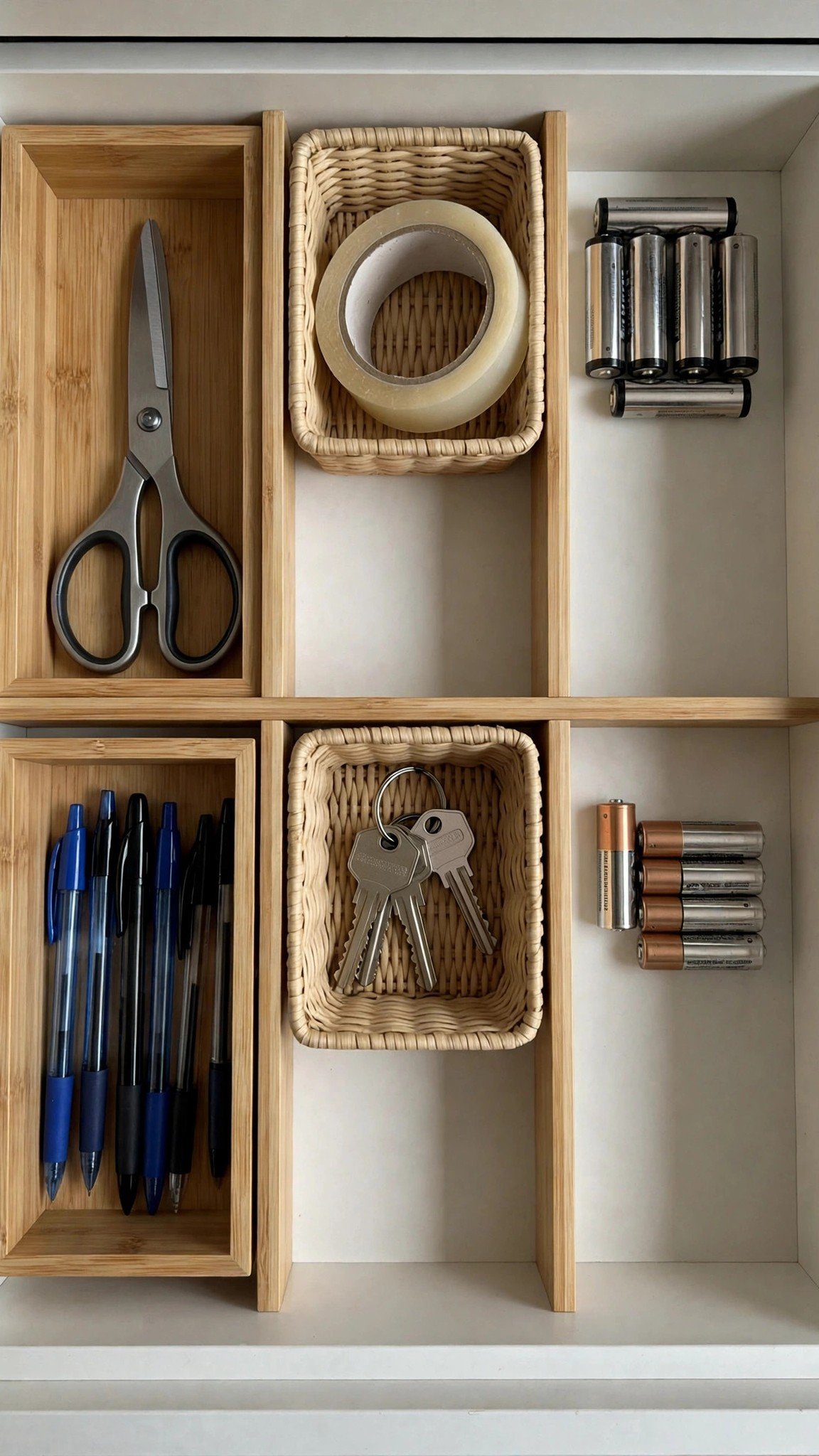
Adjustable spring-loaded or expandable dividers are the backbone of a junk drawer, because they create zones without wasting a centimetre. Place two or three dividers across the drawer to make lanes, then decide what lives in each lane: tools in one, batteries and tape in another, everyday bits in the third.
Dividers work because a drawer without lanes becomes one mixed pile within a week, however neatly it starts. Lanes also make the drawer self-correcting: when something is in the wrong lane, you can see it instantly. Bamboo or plastic both work — pick whichever wipes clean easily. The same zones work across the whole kitchen, as shown in these small kitchen organization ideas.

5. Give Every Category Its Own Zone
Once the dividers are in, assign each lane a single category and nothing else. One lane for fasteners and small tools, one for batteries and chargers, one for tape, scissors, and pens, one for the everyday grab-and-go items like spare keys and coins. No category shares a lane.
Zones work because the drawer stops being a junk drawer the moment everything has a named home. Finding the scissors takes three seconds instead of a dig, and putting things away takes no thought at all — the lane tells you where it goes. If a category has only two items, it still gets its own zone.
6. Corral the Small Stuff in Tiny Bins
Rubber bands, paper clips, pins, and loose screws defeat dividers on their own — they slide under them and migrate. Put each tiny category in its own small bin, ramekin, or mint tin inside its lane. The bin is the boundary the divider cannot provide.
Tiny bins work because small items need a container, not just a zone. A bin also makes the drawer portable in a useful way: lift the bin of batteries out, take what you need, and put it back — the rest of the drawer never gets disturbed. Clear bins are best, so you can see what is inside without opening them.

7. Use the Drawer Sides and Lid
The sides of a deep drawer and the underside of the drawer above are wasted space. Stick a narrow magnetic strip on the side for paper clips and pins, or a small adhesive hook for a measuring tape. If the drawer above has clearance, a slim tray that slides under it doubles the storage.
Side space works because a junk drawer is usually shallow in the middle and deep at the edges — the edges are where the small flat things hide. A magnetic strip turns a dead side wall into the home for every paper clip in the house, and it costs less than a coffee.
8. Label the Zones
Label each lane with a small piece of tape and a marker, or a label maker if you have one: tools, batteries, tape, everyday. Labels feel unnecessary in your own kitchen, until someone else puts the scissors in the battery lane and the system quietly dies.
Labels work because they turn a private system into a household system. Everyone who opens the drawer can see where things belong, and the drawer stays organized without you policing it. Keep the labels short — one word per lane — and replace them when a category changes.

9. Set a One-In, One-Out Rule
A junk drawer fills up because things enter and never leave. Adopt a simple rule: every new item that goes into the drawer pushes one old item out. A new pen means an old pen leaves; a new charger means an old cable goes. The drawer never gets fuller than the day you organized it.
The rule works because it is the only maintenance a junk drawer needs. Without it, the drawer is back to chaos in three months, however good the dividers are. With it, the drawer holds its shape indefinitely, and the monthly reset below becomes a two-minute job instead of a reorganization.
10. Reset It in Five Minutes a Month
Once a month, pull the drawer open and spend five minutes on it: return anything in the wrong lane, toss the dead pens and dried-out batteries, and wipe the base. Five minutes a month is all a zoned drawer needs — the system does the rest.
A monthly reset works because small messes are easy and big messes are not. Five minutes catches the drift before it becomes a jam, and it keeps the drawer feeling like a tool instead of a chore. Put the reset on the same day as another monthly job, so it becomes a habit instead of a reminder.
A Drawer That Finally Works
A junk drawer is not a failure of willpower; it is a drawer without a system. Empty it completely, sort ruthlessly, measure before you buy, divide it into lanes, give every category its own zone, bin the tiny stuff, use the sides, label the lanes, enforce one-in-one-out, and reset it for five minutes a month. Start with the emptying — the rest of the system builds itself from there. Cold storage needs the same system, so try this fridge organization for small kitchens.